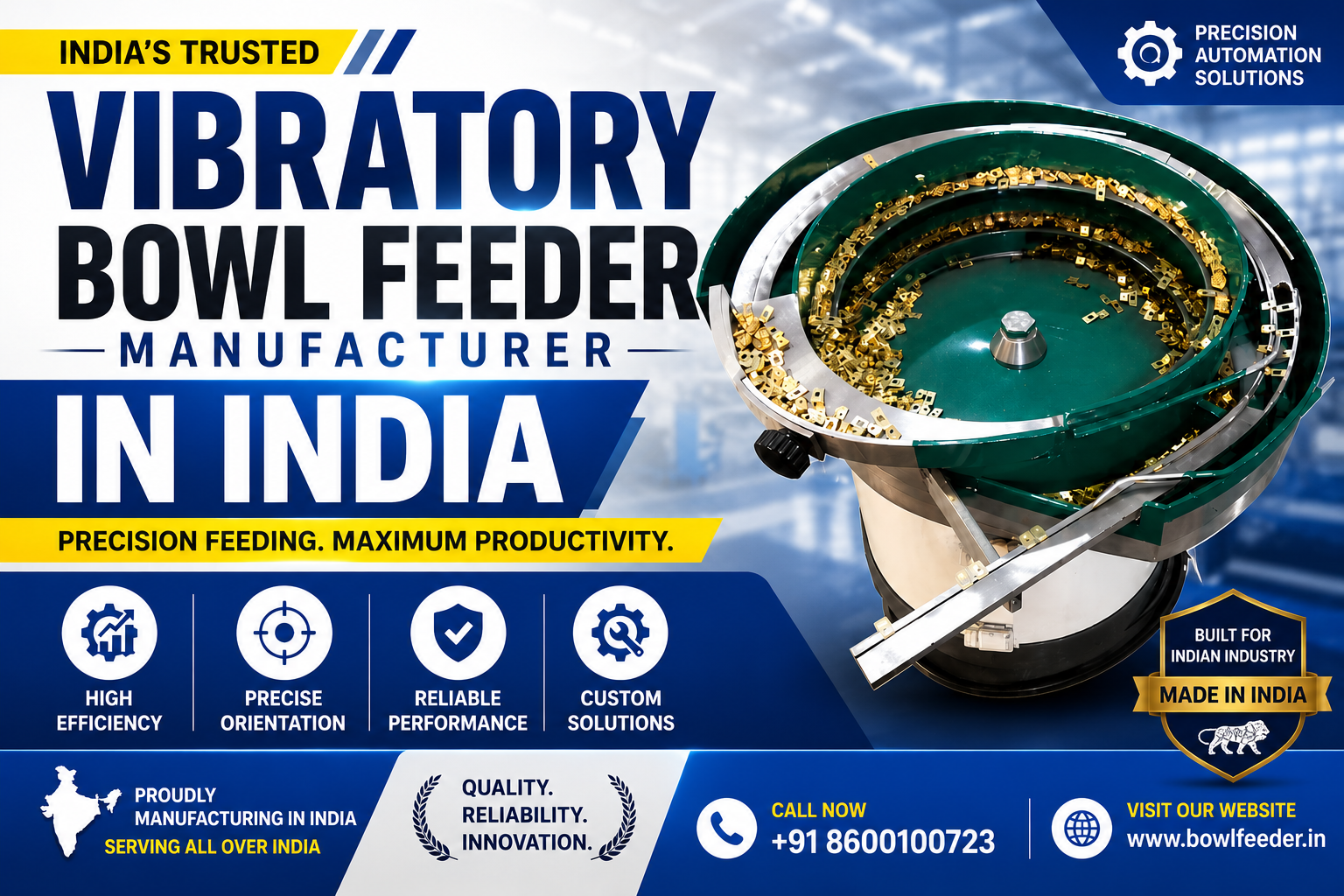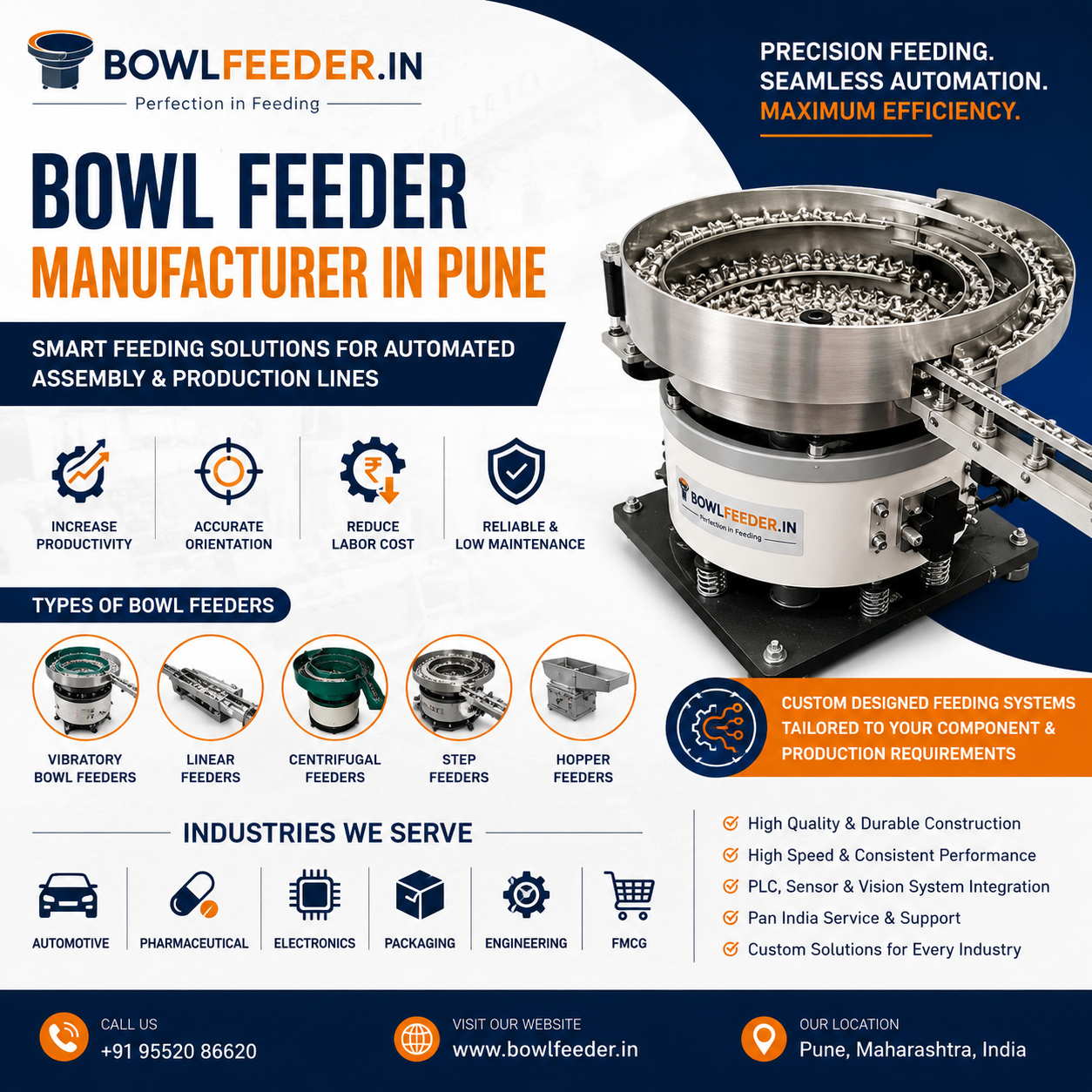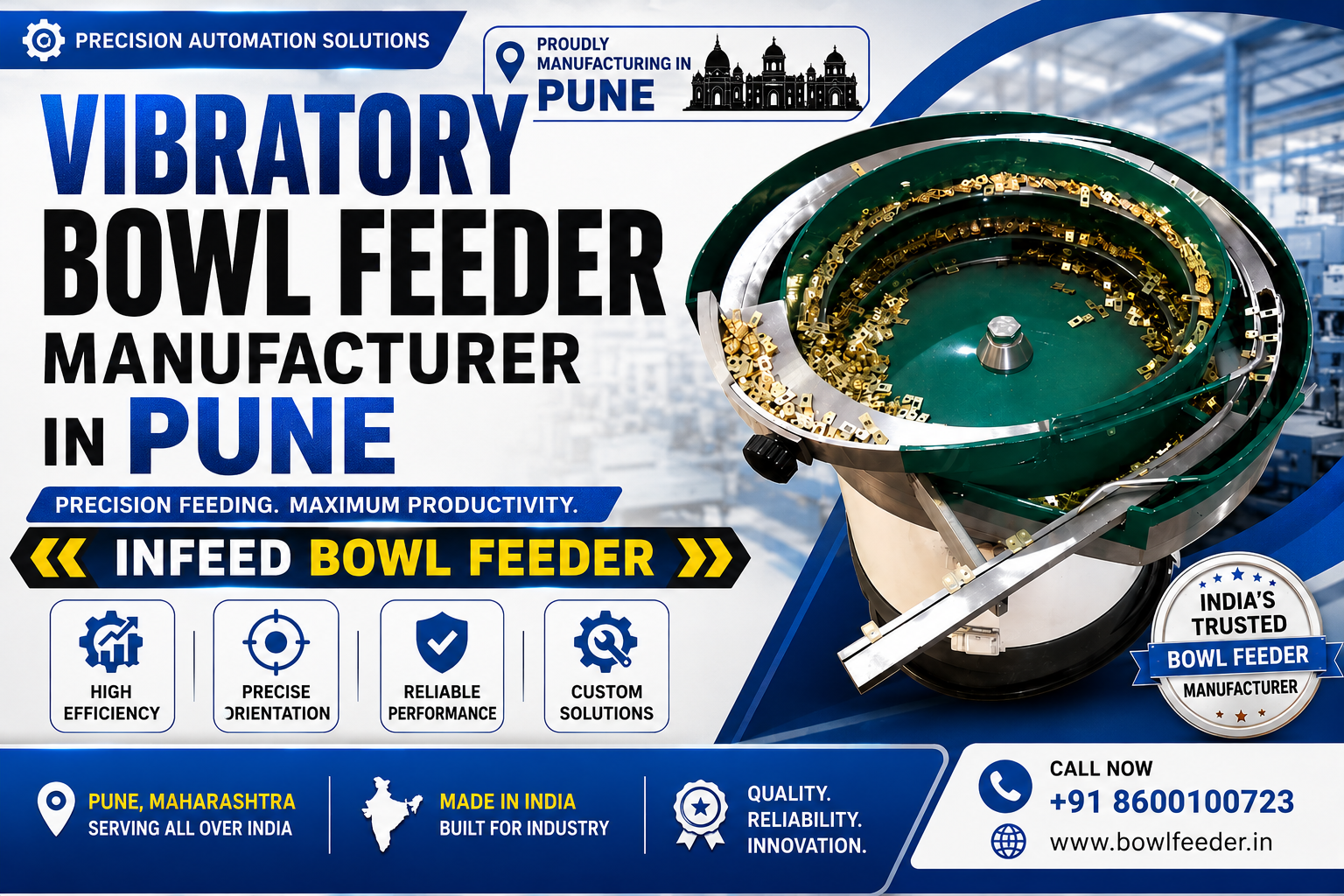
Finding a reliable Bowl Feeder Manufacturer in Pune is important for industries looking to improve production speed, feeding accuracy, and automation efficiency. Bowl feeders are widely used in industrial automation to automatically orient, separate, and feed components to the next stage of a production process.
India’s No. 1
Bowl Feeder Manufacturer
A properly designed bowl feeding system can reduce manual handling, improve productivity, maintain consistent component orientation, and support continuous production.
What Is a Bowl Feeder?
A bowl feeder is an automatic component feeding machine used to handle and orient bulk parts before sending them to an assembly, inspection, packaging, or manufacturing process.
The components are loaded into a specially designed bowl. Through controlled vibration, parts move along a specially designed track. The track helps orient the components correctly and delivers them in a consistent position to the next machine or automation system.
Bowl feeders can be customized according to:
- Component size and shape
- Component material
- Required feeding speed
- Orientation requirements
- Production capacity
- Automation system
- Application requirements
Bowl Feeder Manufacturer in Pune
Pune is one of India’s major industrial and manufacturing hubs, with strong demand for automation solutions across automotive, engineering, pharmaceutical, electrical, electronics, plastic, and consumer product industries.
A professional bowl feeder manufacturer in Pune can provide customized feeding solutions based on the customer’s component and production requirements rather than supplying a standard machine.
Custom bowl feeder solutions can include the bowl, drive unit, linear feeder, sensors, control panel, storage hopper, and other automation components required for continuous component feeding.
Types of Bowl Feeders
Different manufacturing applications require different feeding technologies. Common bowl feeder solutions include:
1. Vibratory Bowl Feeder
Vibratory bowl feeders use controlled vibration to move and orient components. They are commonly used for high-speed automatic feeding applications.
2. Screw Bowl Feeder
A screw bowl feeder is specially designed for feeding screws, fasteners, and similar components. The internal tooling is designed according to the screw’s dimensions and orientation requirements.
3. Pharmaceutical Bowl Feeder
Pharmaceutical feeding applications require hygienic and carefully controlled designs. Stainless-steel construction and application-specific tooling can be used for pharmaceutical automation requirements.
4. Automotive Bowl Feeder
Automotive components often require high-speed, reliable feeding. Bowl feeders can be customized for clips, fasteners, plastic components, metal parts, and other automotive components.
5. Stainless Steel Bowl Feeder
Stainless steel bowl feeders are suitable for applications where durability, cleanliness, corrosion resistance, and easy maintenance are important.
How Does a Vibratory Bowl Feeder Work?
The working principle of a vibratory bowl feeder is relatively simple but requires precise engineering.
Step 1 – Component Loading
Bulk components are placed inside the bowl.
Step 2 – Controlled Vibration
The drive unit generates controlled vibration, causing components to move around the bowl track.
Step 3 – Component Orientation
Specially designed tooling and tracks allow incorrectly positioned components to fall back into the bowl while correctly oriented components continue moving.
Step 4 – Linear Transfer
The oriented components can be transferred to a linear feeder or conveyor for controlled delivery.
Step 5 – Machine Integration
The components are finally delivered to an assembly machine, inspection station, packaging machine, robotic system, or other automated process.
Benefits of Bowl Feeder Automation
A properly designed bowl feeder can provide several advantages for manufacturing companies.
Increased Production Speed
Automatic feeding allows components to be supplied continuously to the production process, helping increase overall production output.
Reduced Manual Handling
Operators do not need to manually pick and orient individual components, reducing repetitive manual work.
Consistent Component Orientation
Customized tooling helps maintain the required orientation of components before they enter the next production stage.
Improved Productivity
Continuous automatic feeding can help reduce production interruptions and improve machine utilization.
Easy Automation Integration
Bowl feeders can be integrated with conveyors, assembly machines, robots, vision inspection systems, packaging machines, and other automation equipment.
Customized Feeding
Every component is different. Bowl feeder tooling can be designed according to the component’s size, shape, material, orientation, and required feeding speed.
Industries Using Bowl Feeders
Bowl feeders are used across many manufacturing industries, including:
- Automotive Industry
- Pharmaceutical Industry
- Electrical Industry
- Electronics Industry
- Plastic Industry
- Engineering Industry
- Hardware Industry
- Fastener Industry
- Packaging Industry
- Consumer Products
- Medical Equipment Manufacturing
- General Industrial Automation
Components That Can Be Fed Using Bowl Feeders
Depending on the bowl design and application, bowl feeders can handle a wide range of components such as:
- Screws
- Nuts
- Bolts
- Washers
- Rivets
- Pins
- Clips
- Springs
- Plastic Components
- Electrical Components
- Rubber Components
- Metal Components
- Fasteners
- Small Precision Parts
The feeding system should be designed according to the exact component because component geometry directly affects orientation and feeding performance.
Why Choose a Custom Bowl Feeder?
A standard bowl feeder may not provide the required performance for every component. Custom engineering allows the feeding system to be developed around the actual production requirement.
Important factors considered during bowl feeder design include:
Component Geometry:
The size, shape, weight, and center of gravity of the component affect feeding performance.
Required Orientation:
The component must reach the machine in the correct orientation.
Feeding Rate:
The feeder should be capable of achieving the required parts-per-minute rate.
Material:
Metal, plastic, rubber, and other materials can require different tooling approaches.
Machine Integration:
The feeder must work properly with the downstream automation equipment.
Bowl Feeder Applications in Automation
Bowl feeders are commonly integrated into automatic production systems such as:
- Automatic Assembly Machines
- Screw Feeding Systems
- Pick-and-Place Machines
- Packaging Machines
- Vision Inspection Systems
- Sorting Machines
- Pressing Machines
- Riveting Machines
- Testing Machines
- Robotic Automation Systems
The bowl feeder acts as an important link between bulk component storage and the automated manufacturing process.
How to Select the Right Bowl Feeder Manufacturer in Pune?
Before selecting a bowl feeder manufacturer, manufacturers should consider several factors.
Component Feeding Experience
Choose a manufacturer with experience handling similar components and applications.
Custom Tooling Capability
The manufacturer should be able to develop tooling according to the component geometry and orientation requirement.
Required Feeding Speed
Clearly communicate the required production rate so the feeder can be designed for the required output.
Material and Construction
Select suitable materials and construction based on the application, environment, cleanliness requirements, and durability expectations.
Automation Integration
Check whether the manufacturer can integrate the bowl feeder with the existing or planned automation system.
Testing and Trials
Component trials are important to verify feeding performance before final installation.
Bowl Feeder Manufacturer for Industrial Automation in Pune
For companies searching for a Bowl Feeder Manufacturer in Pune, the right solution should be based on the actual component and production process.
A professionally engineered bowl feeder can help manufacturers move from manual component handling toward reliable automatic feeding and assembly.
Whether the application involves screws, fasteners, plastic parts, automotive components, pharmaceutical components, electrical parts, or precision engineering components, a customized feeding solution can be developed around the production requirement.
Conclusion
A Bowl Feeder Manufacturer in Pune can play an important role in helping manufacturing companies automate component feeding and improve production efficiency.
From vibratory bowl feeders and screw bowl feeders to customized feeding systems, the right solution depends on the component, required orientation, feeding speed, and automation process.
If you are planning a new automation project or want to replace manual component feeding with an automatic system, selecting a manufacturer with strong customization and application-engineering capabilities can help you achieve reliable and consistent feeding performance.
Looking for a Bowl Feeder Manufacturer in Pune?
For customized bowl feeder requirements, share your component details, component images, required orientation, feeding speed, and application requirements with the manufacturer. This allows the feeding system to be designed according to your actual production needs.
Primary SEO Keyword: Bowl Feeder Manufacturer in Pune
Related Keywords:
Bowl Feeder Manufacturers in Pune, Vibratory Bowl Feeder Manufacturer in Pune, Automatic Bowl Feeder, Screw Bowl Feeder Manufacturer, Industrial Bowl Feeder, Custom Bowl Feeder, Bowl Feeding System, Vibratory Feeder Manufacturer, Automatic Feeding System, Bowl Feeder Supplier in Pune