Bowl Feeder Manufacturer in India
In modern manufacturing, automation, productivity and precision are essential for maintaining consistent production and reducing operating costs. One of the most important components of an automated assembly line is an efficient parts feeding system.
India’s No. 1
Bowl Feeder Manufacturer
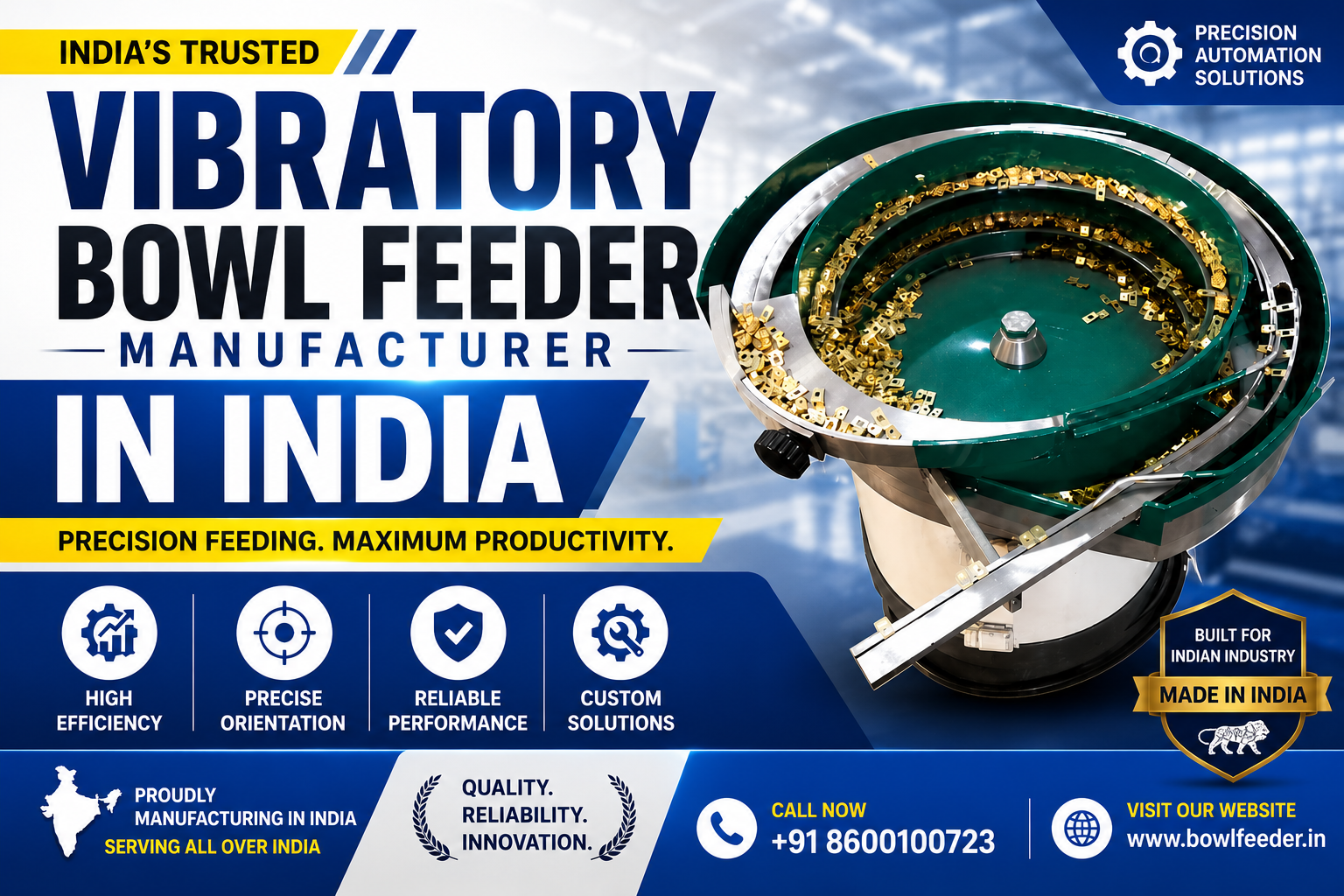
A bowl feeder is an automatic feeding machine designed to orient, separate and deliver components in a controlled direction and at a consistent speed. Bowl feeders are widely used in automotive, pharmaceutical, electrical, electronics, plastic, hardware, packaging and general engineering industries.
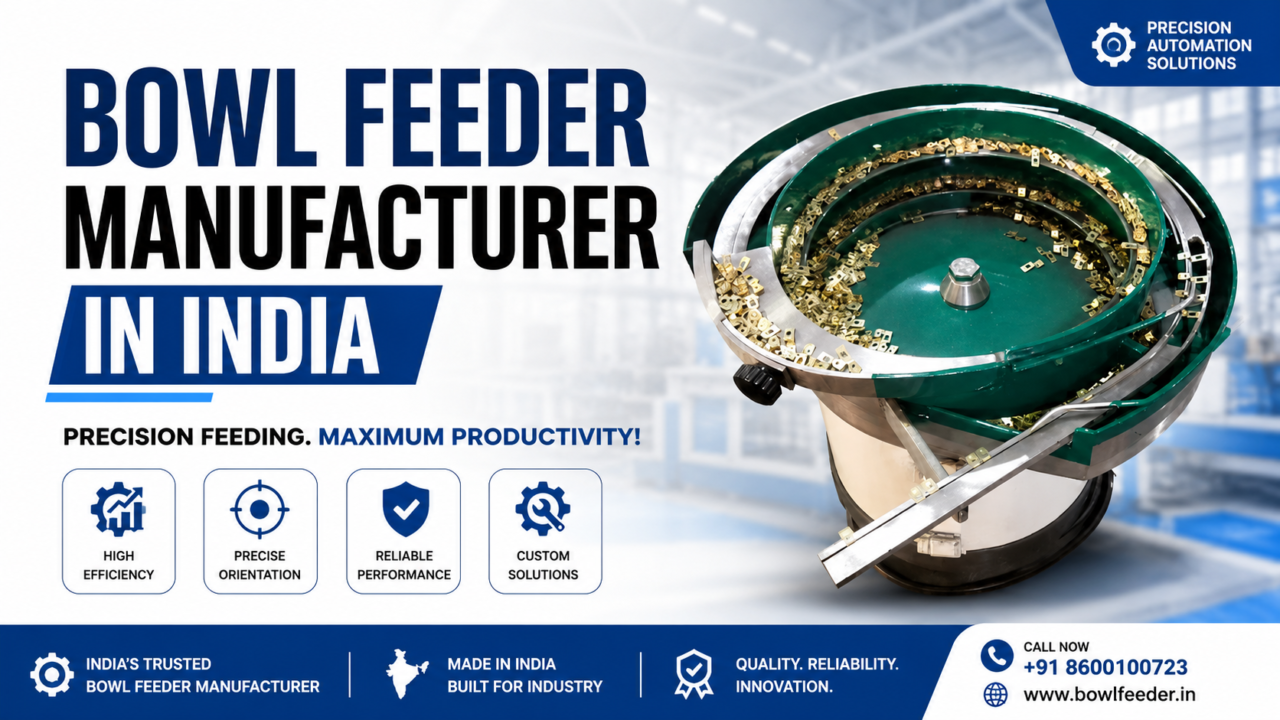
As a professional bowl feeder manufacturer in India, Feed Tech Bowlfeeder provides customized feeding solutions designed according to component shape, size, material, production speed and automation requirements.
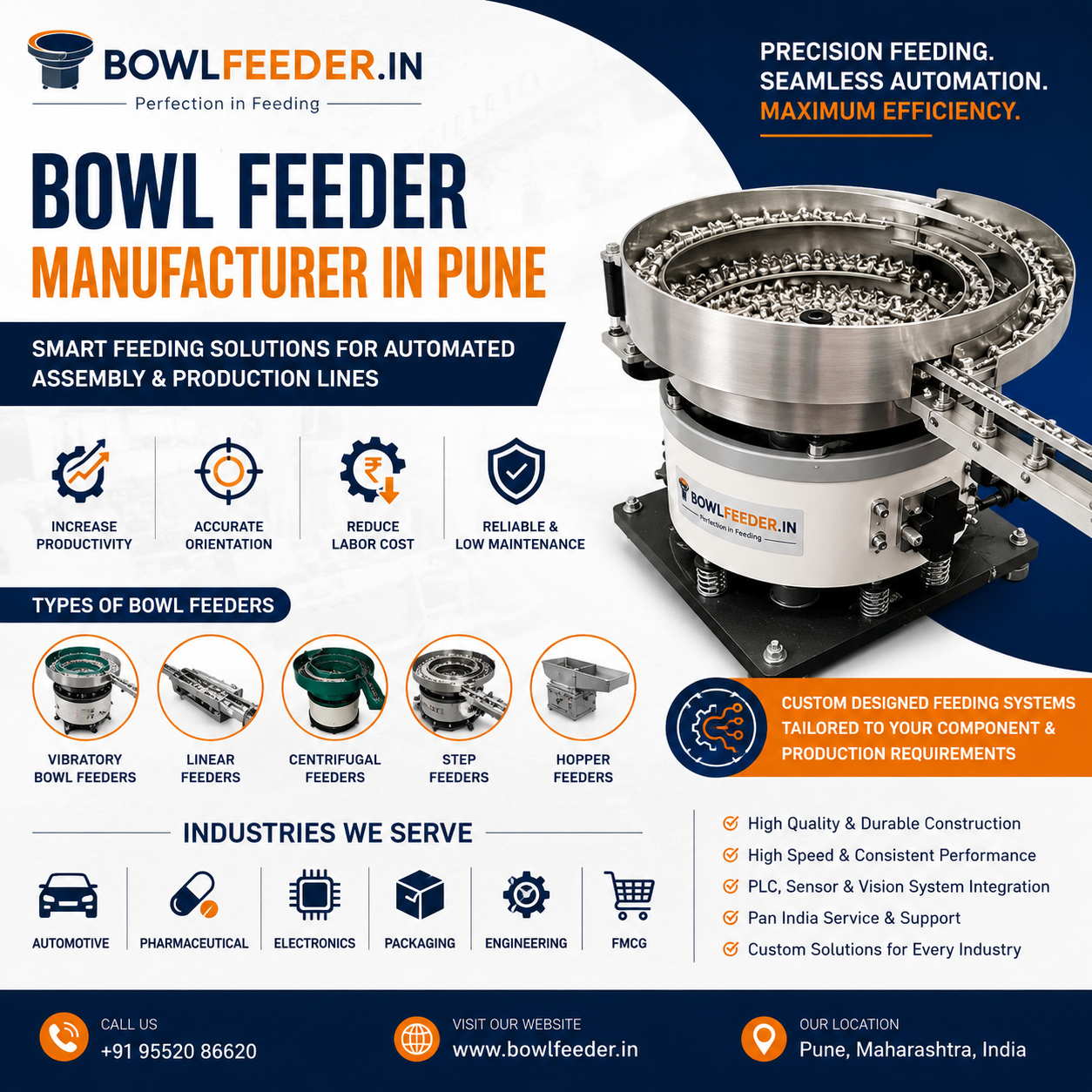
Our solutions include vibratory bowl feeders, centrifugal feeders, step feeders, linear feeders, storage hoppers, elevator feeders and complete automatic feeding systems.
What Is a Bowl Feeder?
A bowl feeder is an automatic component-feeding system that uses controlled vibration or centrifugal movement to move bulk components from a container into a correctly oriented single-file stream.
The basic feeding process generally involves:
Bulk Components → Bowl → Orientation → Separation → Linear Feeding → Automation Machine
The feeder automatically selects and positions components so that they can be supplied to the next operation, such as assembly, inspection, pressing, packaging, testing or insertion.
This eliminates many repetitive manual feeding operations and helps manufacturers achieve higher production efficiency.
How Does a Vibratory Bowl Feeder Work?
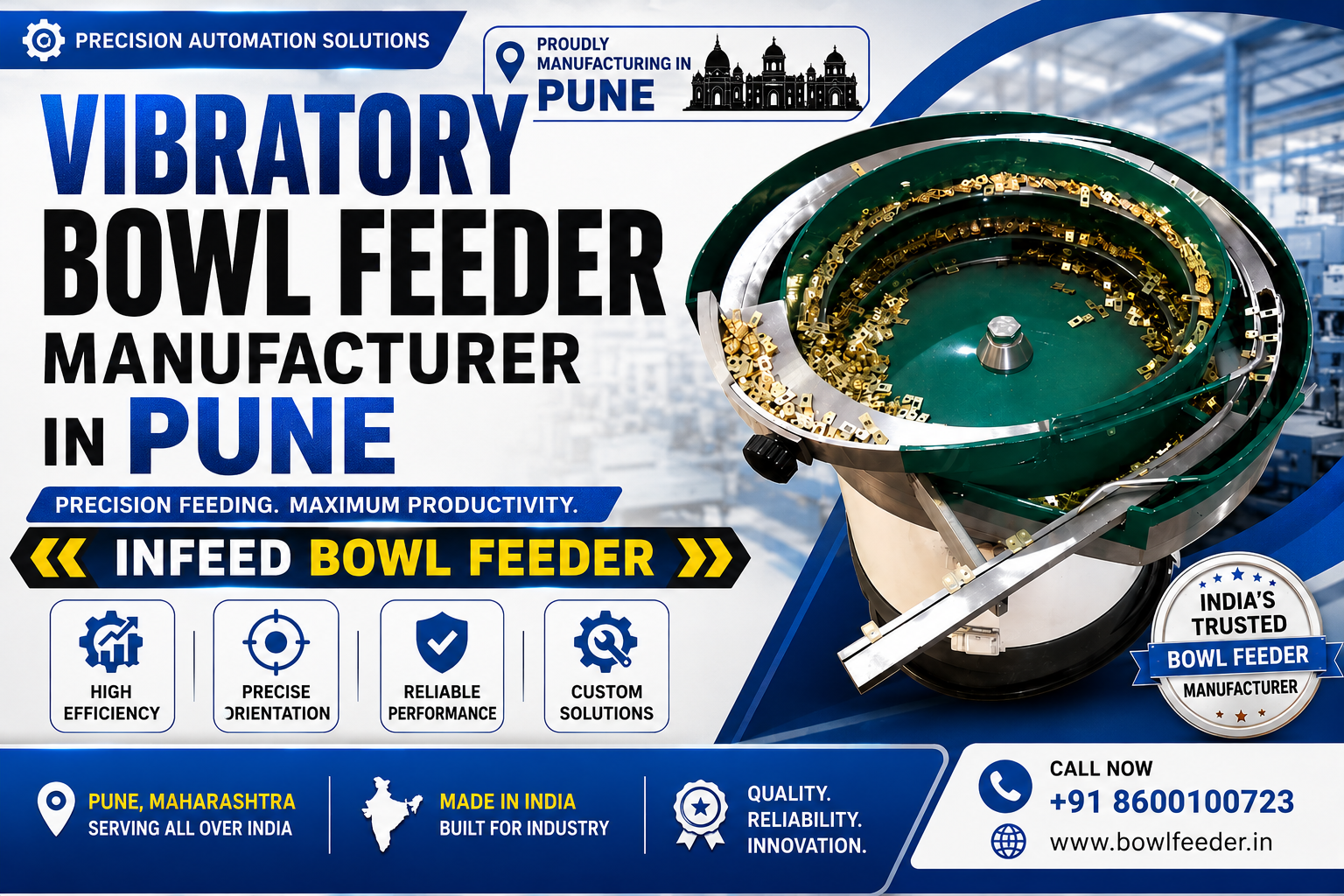
A vibratory bowl feeder consists of a specially designed bowl mounted on a vibration-generating drive unit.
When vibration is applied, components inside the bowl move along a specially designed track. The track contains customized tooling and orientation features that allow correctly positioned components to continue toward the outlet while incorrectly oriented components are returned to the bowl.
Typical Working Process
- Components are loaded into the bowl.
- The electromagnetic or other suitable drive generates controlled vibration.
- Components move along the spiral track.
- Orientation tooling separates incorrectly positioned parts.
- Correctly oriented components continue toward the outlet.
- A linear feeder can transfer components to the required position.
- Sensors can monitor component flow.
- The component is supplied to the automated machine.
The tooling inside the bowl is customized according to the component geometry.
Why Choose a Bowl Feeder for Industrial Automation?
A properly designed bowl feeder can provide several advantages over manual component feeding.
Key Benefits
- High-speed component feeding
- Consistent part orientation
- Reduced manual handling
- Improved production efficiency
- Continuous component supply
- Reduced labour dependency
- Improved assembly-line productivity
- Better feeding accuracy
- Easy integration with automation machines
- Customized component handling
- Improved production consistency
- Reduced operator fatigue
- Suitable for continuous production
For high-volume manufacturing, automated feeding can become an important part of a complete production automation strategy.
Types of Bowl Feeders Available in India
Different components require different feeding technologies. A professional bowl feeder manufacturer in India should select the feeder based on component characteristics and production requirements.
1. Vibratory Bowl Feeder
The vibratory bowl feeder is one of the most widely used automatic feeding solutions.
It uses controlled vibration to move and orient components along a customized track.
Applications
- Automotive components
- Fasteners
- Plastic components
- Electrical components
- Electronic parts
- Hardware components
- Small engineering parts
- Assembly components
2. Centrifugal Bowl Feeder
A centrifugal feeder uses rotational movement rather than conventional vibration to move components.
It can be suitable for applications requiring high feeding rates and gentle handling of certain components.
Advantages
- High-speed feeding
- Continuous component flow
- Suitable for high-volume production
- Reduced vibration compared with conventional vibratory systems
- Suitable for selected delicate components
3. Step Feeder
A step feeder uses a stepping mechanism to lift components from a bulk storage area and transfer them toward the feeding track.
Step feeders can be useful when manufacturers require:
- Low-noise operation
- Gentle component handling
- High-volume feeding
- Large component storage capacity
- Reduced component damage
4. Linear Feeder
A linear feeder is generally used after the bowl feeder to transport correctly oriented components toward the automation station.
It provides controlled movement between the bowl feeder and the machine.
A typical system may therefore combine:
Bowl Feeder + Linear Feeder + Sensors + Automation Machine
5. Storage Hopper
A storage hopper can be installed above or near the feeding system to provide additional component storage.
It reduces the frequency of manual loading and can support longer periods of automated operation.
6. Elevator Feeder
An elevator feeder is designed to transfer components from a lower storage area to a higher feeding position.
It can be useful when:
- Large quantities of components need to be stored
- The feeding system requires elevated material transfer
- Continuous production is required
- Floor-space utilization is important
Customized Bowl Feeder Manufacturing
Every industrial component is different.
A standard bowl feeder may not provide the required feeding performance for every application. Component dimensions, weight, surface finish, geometry and orientation requirements can significantly affect feeder design.
That is why custom bowl feeder manufacturing is important.
A customized bowl feeder can be designed according to:
- Component dimensions
- Component weight
- Component material
- Component shape
- Surface finish
- Required orientation
- Production rate
- Feeding distance
- Automation machine design
- Available installation space
- Required hopper capacity
- Sensor requirements
- PLC integration
- Inspection requirements
The bowl tooling is developed specifically for the component and required orientation.
Bowl Feeder Applications by Industry
Bowl feeders are used across a wide range of manufacturing industries.
Automotive Industry
Automotive manufacturing requires reliable feeding of components at high production speeds.
Bowl feeders can be used for:
- Fasteners
- Clips
- Bushes
- Pins
- Washers
- Plastic automotive components
- Small metal components
- Assembly parts
Automated feeding helps maintain a continuous supply of components to assembly and testing machines.
Pharmaceutical Industry
Pharmaceutical manufacturing requires hygienic and reliable equipment.
Pharmaceutical bowl feeders can be designed using suitable stainless-steel construction and application-specific components.
Potential applications include:
- Caps
- Closures
- Small containers
- Pharmaceutical components
- Packaging components
- Medical-device components
Depending on the application, designs may incorporate hygienic construction and appropriate materials.
Food Industry
Food and packaging applications can require specialized feeding systems for components such as:
- Caps
- Lids
- Closures
- Packaging components
- Small food-processing components
The feeder design should be selected according to hygiene, material-handling and production requirements.
Plastic Industry
Plastic components are commonly manufactured in large quantities and often require automatic orientation before assembly.
Bowl feeders can handle:
- Plastic caps
- Clips
- Connectors
- Injection-moulded parts
- Small plastic components
- Packaging components
Customized tooling helps achieve reliable orientation.
Electrical and Electronics Industry
Bowl feeders are widely applicable to small electrical and electronic components.
Examples include:
- Connectors
- Terminals
- Pins
- Switch components
- Small housings
- Fasteners
- Electronic assembly parts
Automatic feeding can help improve assembly-line consistency.
Stainless Steel Bowl Feeder
A stainless steel bowl feeder can be selected for applications where corrosion resistance, durability and specific hygiene requirements are important.
Depending on the application, manufacturers may use stainless-steel construction and customized surface finishing.
Stainless steel bowl feeders are commonly considered for:
- Pharmaceutical applications
- Food-related applications
- Medical-device applications
- Chemical-related manufacturing
- Clean manufacturing environments
The correct material and surface finish should always be selected according to the actual application requirements.
Bowl Feeder Integration With Automation
A bowl feeder is often only one part of a complete automation system.
A complete automated feeding solution can include:
Storage Hopper → Bowl Feeder → Linear Feeder → Sensors → Vision Inspection → Pick & Place → Assembly Machine
Depending on production requirements, additional systems can include:
- PLC control
- HMI interface
- Sensors
- Vision inspection
- Rejection mechanisms
- Pneumatic systems
- Servo systems
- Robotic pick-and-place
- Traceability
- Poka-yoke systems
- Automatic counting
- Quality inspection
This allows the feeding system to become part of a complete automated manufacturing process.
How to Select the Right Bowl Feeder?
Choosing the correct feeder is important for achieving reliable production performance.
Before selecting a bowl feeder manufacturer in India, manufacturers should consider the following parameters.
1. Component Size
Measure the overall length, width, height and critical dimensions of the component.
2. Component Weight
Very light and very heavy components may require different feeding technologies.
3. Component Material
Steel, stainless steel, plastic, rubber and other materials can behave differently during feeding.
4. Component Shape
Irregular components generally require more specialized orientation tooling.
5. Required Orientation
Clearly define how the component must be presented to the next machine.
6. Production Speed
The required parts-per-minute rate is one of the most important parameters when designing a feeding system.
7. Feeding Distance
The distance between the feeder and the automation station should be considered during system design.
8. Environmental Requirements
Dust, temperature, cleanliness and hygiene requirements can influence the feeder design.
9. Automation Integration
The feeder should be compatible with the machine, sensors, PLC, HMI and other automation equipment.
Bowl Feeder Manufacturer vs Bowl Feeder Supplier
When purchasing an industrial feeding system, it is useful to understand the difference between a manufacturer and a reseller.
A bowl feeder manufacturer can typically provide greater control over:
- Feeder design
- Bowl tooling
- Component testing
- Customization
- Automation integration
- Technical support
- Production optimization
- After-sales service
For complex industrial applications, working directly with a manufacturer can simplify communication between the component requirements and the final feeder design.
Why Choose Feed Tech Bowlfeeder?
Feed Tech Bowlfeeder focuses on designing and manufacturing customized industrial feeding solutions for different component-handling applications.
Our solutions can be developed for industries including:
- Automotive
- Pharmaceutical
- Food
- Plastic
- Electrical
- Electronics
- General engineering
- Packaging
- Medical devices
Our Feeding Solutions
- Vibratory Bowl Feeders
- Linear Feeders
- Centrifugal Feeders
- Step Feeders
- Storage Hoppers
- Elevator Feeders
- Complete Feeding Systems
- Vision Inspection Systems
- Custom Automation Machines
- Pharma Bowl Feeders
- Automotive Bowl Feeders
- Stainless Steel Bowl Feeders
Our objective is to provide reliable component feeding and automation solutions based on actual production requirements.
Benefits of Working With an Experienced Bowl Feeder Manufacturer
An experienced manufacturer can help customers move from a basic component sample to a complete feeding solution.
The development process may include:
Component Study
The component is evaluated for dimensions, material, geometry and orientation requirements.
Feeding Trial
Sample components are tested to understand feeding behaviour and orientation challenges.
Tooling Development
Customized track tooling is developed according to the required orientation.
Speed Optimization
The system is adjusted according to the required production rate.
Automation Integration
Sensors, linear feeders, PLC systems and other equipment can be integrated as required.
Final Testing
The completed system is tested before delivery according to the agreed application requirements.
Frequently Asked Questions About Bowl Feeders
What is a bowl feeder?
A bowl feeder is an automatic feeding machine that moves, separates and orients bulk components before supplying them to an automated manufacturing process.
What is a vibratory bowl feeder?
A vibratory bowl feeder uses controlled vibration to move components along a specially designed bowl track and orient them into the required position.
How much does a bowl feeder cost in India?
The cost depends on factors such as component size, material, production speed, bowl size, tooling complexity, sensors, automation integration and customization. A manufacturer should evaluate the application before providing an accurate quotation.
Can bowl feeders handle different components?
Yes. Bowl feeders can be customized for different component shapes, sizes, materials and orientation requirements. However, separate tooling or feeder configurations may be required for significantly different components.
Can a bowl feeder be integrated with a PLC?
Yes. Bowl feeders can be integrated with PLC-based automation systems depending on the machine architecture and control requirements.
Which industries use bowl feeders?
Bowl feeders are commonly used in automotive, pharmaceutical, food, plastic, electrical, electronics, packaging, medical-device and general engineering applications.
What information is required for a bowl feeder quotation?
A manufacturer may require component drawings or samples, dimensions, material, weight, required orientation, production speed, feeding distance and automation details.
Can bowl feeders be customized?
Yes. Customization is one of the most important aspects of industrial bowl feeder design. Bowl tooling, feeder size, sensors, controls and automation interfaces can be designed according to application requirements.
Conclusion
A reliable bowl feeder manufacturer in India can help manufacturers automate repetitive component-feeding operations, improve production consistency and reduce manual handling.
From vibratory bowl feeders and centrifugal feeders to step feeders, linear feeders, hoppers and complete feeding systems, the right solution depends on the component and production requirements.
Feed Tech Bowlfeeder provides customized feeding solutions for industries such as automotive, pharmaceutical, food, plastic, electrical, electronics and general engineering.
If you are planning to automate component feeding, the best approach is to evaluate the component, required orientation, production speed and machine integration requirements before selecting the feeder.
Looking for a Bowl Feeder Manufacturer in India?
If you need a custom bowl feeder, vibratory bowl feeder, centrifugal feeder, linear feeder or complete automatic feeding system, contact Feed Tech Bowlfeeder for an application-specific solution.
📞 Contact: +91 8600100723
📧 Email: sale@bowlfeeder.in
🌐 Website: bowlfeeder.in
Send your component details, drawing or sample requirements to discuss the right automatic feeding solution for your production line.