Introduction: The Critical Role of Bowl Feeders in Automation
In modern manufacturing and assembly operations, efficiency hinges on reliable part-feeding systems. Bowl feeders are essential components that automatically orient and singulate parts for downstream processing—whether that’s assembly, machining, inspection, or packaging.
India’s No. 1
Bowl Feeder Manufacturer
But there’s a catch: not all bowl feeders work the same way.
Two primary technologies dominate the market: vibratory bowl feeders and rotary bowl feeders. Both serve the same purpose, but their mechanisms, performance characteristics, and suitability for different applications vary significantly.
This guide breaks down the key differences, advantages, and drawbacks of each system to help you make an informed decision for your specific manufacturing environment.
What Are Vibratory Bowl Feeders?
How Vibratory Bowl Feeders Work
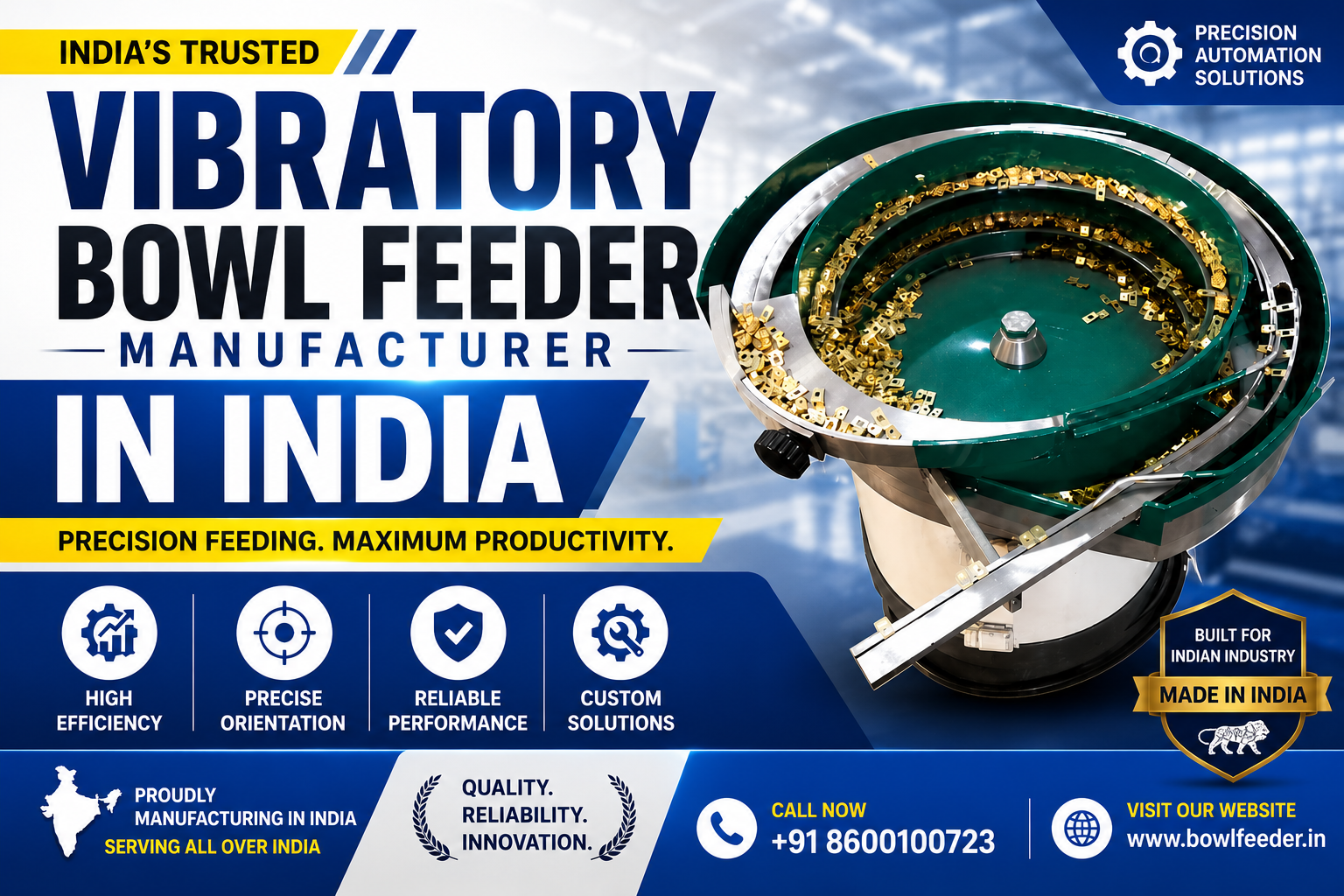
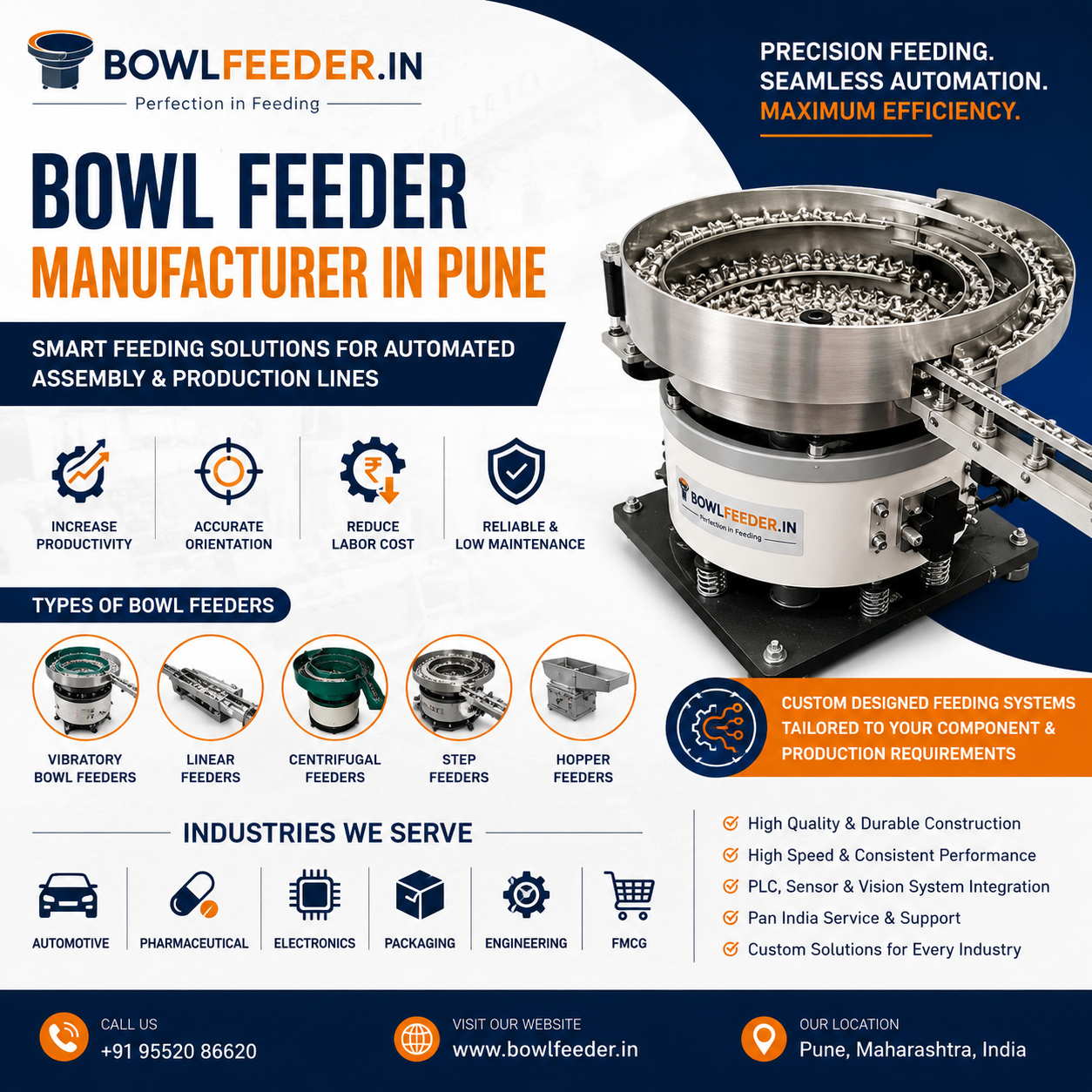
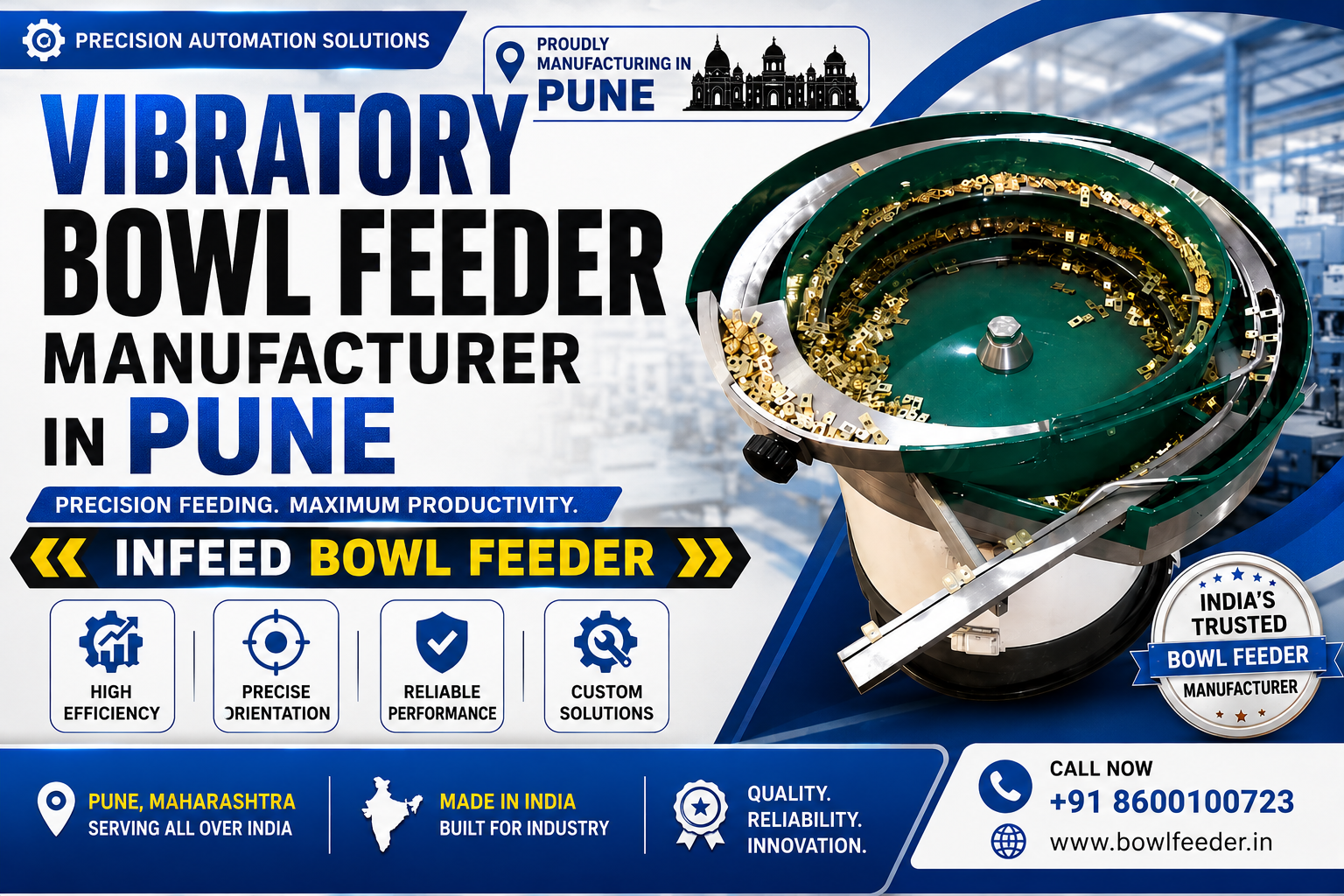
Vibratory bowl feeders use oscillating or vibrating motion to move parts up an inclined, spiraling track inside a bowl. The vibration frequency and amplitude are carefully controlled to:
- Lift parts slightly on each oscillation cycle
- Allow controlled descent along the spiraling track
- Orient parts as they progress toward the discharge point
- Singulate parts (separate them into a single-file line)
The bowl itself is mounted on springs and driven by an electromagnetic or pneumatic vibrator. Parts naturally settle into the most stable orientation due to the spiral track’s geometry and the vibratory motion—a process called “natural selection.”
Key Characteristics
| Feature | Details |
|---|---|
| Motion Type | Linear or circular vibration |
| Feed Rate | Typically 20–200 parts per minute |
| Part Orientation | Passive (gravity-based) |
| Noise Level | Moderate to high (60–75 dB) |
| Power Consumption | 0.5–2 kW depending on size |
| Maintenance | Regular cleaning, spring replacement |
| Cost | Lower initial investment ($5,000–$20,000) |
What Are Rotary Bowl Feeders?
How Rotary Bowl Feeders Work
Rotary bowl feeders employ continuous rotational motion to move parts around a bowl. Key mechanisms include:
- Rotating bowl or carousel that spins at controlled speeds
- Angled flight fingers or baffles that guide parts upward
- Active orientation devices (sometimes mechanical fingers or air jets) that position parts precisely
- Gentle, continuous motion that prevents part damage
As the bowl rotates, parts are carried along the wall and progressively moved toward an exit gate or discharge point. Unlike vibratory feeders, rotary systems can actively orient parts using mechanical or pneumatic guidance.
Key Characteristics
| Feature | Details |
|---|---|
| Motion Type | Continuous rotation (30–100 RPM typical) |
| Feed Rate | Typically 30–300 parts per minute |
| Part Orientation | Active (mechanical/pneumatic control) |
| Noise Level | Low to moderate (50–65 dB) |
| Power Consumption | 0.3–1.5 kW depending on size |
| Maintenance | Lower due to fewer moving parts |
| Cost | Higher initial investment ($15,000–$40,000) |
Head-to-Head Comparison
1. Feeding Speed & Throughput
Winner: Rotary Bowl Feeders (slight edge)
- Vibratory: Typically achieves 20–200 parts/minute depending on part complexity and weight
- Rotary: Often reaches 30–300 parts/minute with smoother, more predictable flow
Rotary feeders excel when high throughput is critical, though vibratory systems can match performance for simpler parts.
2. Part Damage & Material Compatibility
Winner: Rotary Bowl Feeders
Vibratory feeders use repeated impacts and vibration, which can damage:
- Delicate electronics or plastics
- Painted or anodized surfaces
- Precision-finished components
Rotary feeders employ gentler, continuous motion—ideal for fragile or expensive parts. They’re the standard choice in electronics assembly and pharmaceutical industries.
3. Part Orientation Accuracy
Winner: Rotary Bowl Feeders
- Vibratory: Passive orientation relies on spiral geometry and gravity; it is less predictable for complex shapes
- Rotary: Active orientation mechanisms (mechanical fingers, sensors, air jets) ensure consistent, repeatable positioning
This matters when downstream equipment requires precise part presentation.
4. Noise Levels
Winner: Rotary Bowl Feeders
- Vibratory: 60–75 dB (annoying in confined spaces; hearing protection recommended)
- Rotary: 50–65 dB (quieter, more workplace-friendly)
In facilities with multiple feeders or tight spaces, rotary systems reduce operator fatigue and hearing risk.
5. Maintenance Requirements
Winner: Rotary Bowl Feeders
- Vibratory: Springs wear out, vibrator contacts degrade, and electromagnetic coils need periodic adjustment
- Rotary: Fewer moving parts; primarily bearing and seal maintenance
Long-term maintenance costs favor rotary systems.
6. Initial Investment & ROI
Winner: Vibratory Bowl Feeders
- Vibratory: $5,000–$20,000 (more budget-friendly)
- Rotary: $15,000–$40,000 (higher upfront cost)
For startups or cost-sensitive operations, vibratory feeders offer faster payback periods.
7. Space Requirements
Winner: Vibratory Bowl Feeders (slight edge)
Vibratory bowls can be more compact vertically since they use spiral tracks. Rotary systems require more diameter for part circulation but less height.
8. Flexibility for Multiple Part Types
Winner: Vibratory Bowl Feeders
Changing the spiral track or track geometry can adapt vibratory feeders to different parts. Rotary systems require more significant mechanical adjustments or separate bowls for different part shapes.
Vibratory Bowl Feeders: Advantages & Disadvantages
Advantages
✅ Lower cost – Budget-friendly for smaller operations
✅ Simple design – Fewer components mean easier troubleshooting
✅ Compact footprint – Minimal space requirements
✅ Proven technology – Decades of industrial use
✅ Flexible for variety – Can adapt to different part geometries with track changes
✅ Fast setup – Relatively quick to install and configure
Disadvantages
❌ Noise generation – Vibration creates 60–75 dB sound levels
❌ Part damage risk – Not suitable for delicate or finished components
❌ Lower throughput – Slower for high-volume operations
❌ Passive orientation – Limited control over exact part positioning
❌ Maintenance intensity – Springs and vibrators require regular service
❌ Vibration spillover – Can disturb adjacent equipment
Rotary Bowl Feeders: Advantages & Disadvantages
Advantages
✅ Gentle handling – Ideal for delicate parts
✅ Higher speeds – Better for high-volume production
✅ Active orientation – Precise, repeatable part positioning
✅ Low noise – 50–65 dB operating range
✅ Lower maintenance – Fewer moving parts and wear items
✅ Smooth operation – Continuous motion without vibration
✅ Scalability – Can handle larger, heavier parts
Disadvantages
❌ Higher capital cost – $15,000–$40,000+ investment
❌ More complex – Advanced controls and sensors required
❌ Requires skilled setup – More technical knowledge is needed for configuration
❌ Larger footprint – Bowl diameter can be significant
❌ Less flexible – Harder to reconfigure for drastically different parts
How to Choose: A Decision Matrix
Use this framework to select the right feeder for your application:
Choose Vibratory Bowl Feeders If:
- ✓ Budget is constrained ($5,000–$20,000 max)
- ✓ Parts are robust (metal, hard plastic)
- ✓ Moderate throughput needed (under 150 parts/min)
- ✓ Simple geometries (standard shapes)
- ✓ Noise is not a significant concern
- ✓ You need flexibility to switch between part types
- ✓ Existing facility already uses vibratory systems (compatibility)
Ideal Industries: Light assembly, small metal components, fastener handling, basic packaging
Choose Rotary Bowl Feeders If:
- ✓ Budget allows ($15,000–$40,000+)
- ✓ Parts are delicate or finished (electronics, optics, painted surfaces)
- ✓ High throughput is critical (200+ parts/min)
- ✓ Complex part geometries (require active orientation)
- ✓ Noise must be minimized (regulatory or workplace requirements)
- ✓ Precision positioning is essential for downstream equipment
- ✓ Long-term reliability and low maintenance are priorities
Ideal Industries: Electronics assembly, pharmaceutical, medical devices, precision machining, optics manufacturing
Real-World Application Examples
Vibratory Bowl Feeders Work Best For:
- Fastener Distribution – Sorting bolts, nuts, and screws for assembly lines
- Metal Stamping – Feeding flat metal blanks into presses
- Basic Automotive – Orienting simple metal components
- Small Bearing Feeders – Singulating ball bearings (standard sizes)
Rotary Bowl Feeders Work Best For:
- PCB Assembly – Feeding delicate electronic components without damage
- Pharmaceutical Tablets – Gentle handling of fragile tablets and capsules
- Precision Bearings – Complex bearing arrangements requiring exact orientation
- Optical Components – Positioning lenses and precision optics without scratching
Hybrid Approaches & Modern Innovations
The industry is evolving beyond simple binary choices:
Dual-Bowl Systems
Combining vibratory pre-feeding with rotary final positioning—best of both worlds for mixed workloads.
Smart Rotary Feeders
AI and vision-based systems that adapt to part variations in real-time, improving accuracy and speed.
Adjustable Frequency Vibratory Systems
Modern variable-frequency drives allow tuning vibration patterns to specific part types without hardware changes.
Modular Bowl Designs
Quick-change bowls and tracks reduce changeover time between part types.
Cost Comparison: Total Cost of Ownership
Don’t just compare purchase price—consider the full lifecycle:
| Cost Factor | Vibratory | Rotary |
|---|---|---|
| Initial Purchase | $5K–$20K | $15K–$40K |
| Installation | $2K–$5K | $5K–$10K |
| Annual Maintenance | $2K–$5K | $1K–$3K |
| Energy (per year) | $600–$1,500 | $400–$1,000 |
| 5-Year TCO (estimate) | $20K–$45K | $30K–$65K |
However, the rotary feeder may provide better ROI through:
- Fewer unplanned downtime events
- Higher throughput justifies the investment
- Reduced part scrap from damage
- Lower worker injury risk (less noise/vibration)
Frequently Asked Questions
Q1: Can I use a vibratory bowl feeder for fragile electronics?
A: Not recommended. The repetitive vibration and impacts can damage sensitive components. Rotary feeders with gentle handling are the industry standard for electronics.
Q2: What’s the typical lifespan of each type?
A: Both can last 7–10 years with proper maintenance. Rotary systems often exceed 10 years due to fewer wear components.
Q3: Can I upgrade a vibratory feeder to handle faster speeds?
A: Limited—you’re constrained by the vibratory mechanism’s physics. A rotary system may be a better long-term investment for higher throughput.
Q4: Which is easier to troubleshoot?
A: Vibratory systems are simpler mechanically, but rotary systems have better diagnostic tools (sensors, controls). Overall, rotary systems are easier to diagnose due to feedback mechanisms.
Q5: Is one system more environmentally friendly?
A: Rotary systems consume slightly less energy and produce fewer vibrations, making them marginally more eco-friendly.
Q6: Can I use both systems in the same production line?
A: Yes—this is a smart hybrid approach. Use vibratory feeders for robust parts and rotary for delicate components.
Key Takeaways
| Aspect | Vibratory | Rotary |
|---|---|---|
| Best For | Cost-sensitive, robust parts | Precision, delicate components |
| Speed | Moderate | High |
| Gentle Handling | Poor | Excellent |
| Noise | High | Low |
| Cost | Low-to-moderate | Moderate-to-high |
| Maintenance | Higher | Lower |
| Flexibility | Good (track changes) | Limited |
Conclusion: Making Your Decision
There is no universally “best” bowl feeder—the choice depends on your specific application, budget, and production requirements.
Start with these questions:
- What is your annual production volume?
- Are your parts delicate or robust?
- What is your budget for capital equipment?
- Is noise a concern in your facility?
- How important is positioning accuracy?
Vibratory bowl feeders remain the workhorse of industrial automation—proven, affordable, and reliable for countless applications. Rotary bowl feeders represent the modern evolution, offering precision and gentle handling for advanced manufacturing.
The best choice is the one that maximizes your production efficiency while staying within budget and meeting your quality standards.