Introduction
In modern manufacturing, every second counts. Production delays cost money, and inefficient processes drain resources. One simple yet powerful solution that thousands of manufacturers worldwide have adopted is the bowl feeder — an automated parts feeding system that quietly transforms production lines.
India’s No. 1
Bowl Feeder Manufacturer
If you’re managing a manufacturing operation, you’ve likely heard about vibratory feeders. But do you understand how they work and why they deliver such impressive efficiency gains? This comprehensive guide explores how bowl feeders increase production efficiency, reduce labor costs, and enable manufacturers to scale operations without proportional cost increases.
What Are Bowl Feeders?
Understanding the Basics
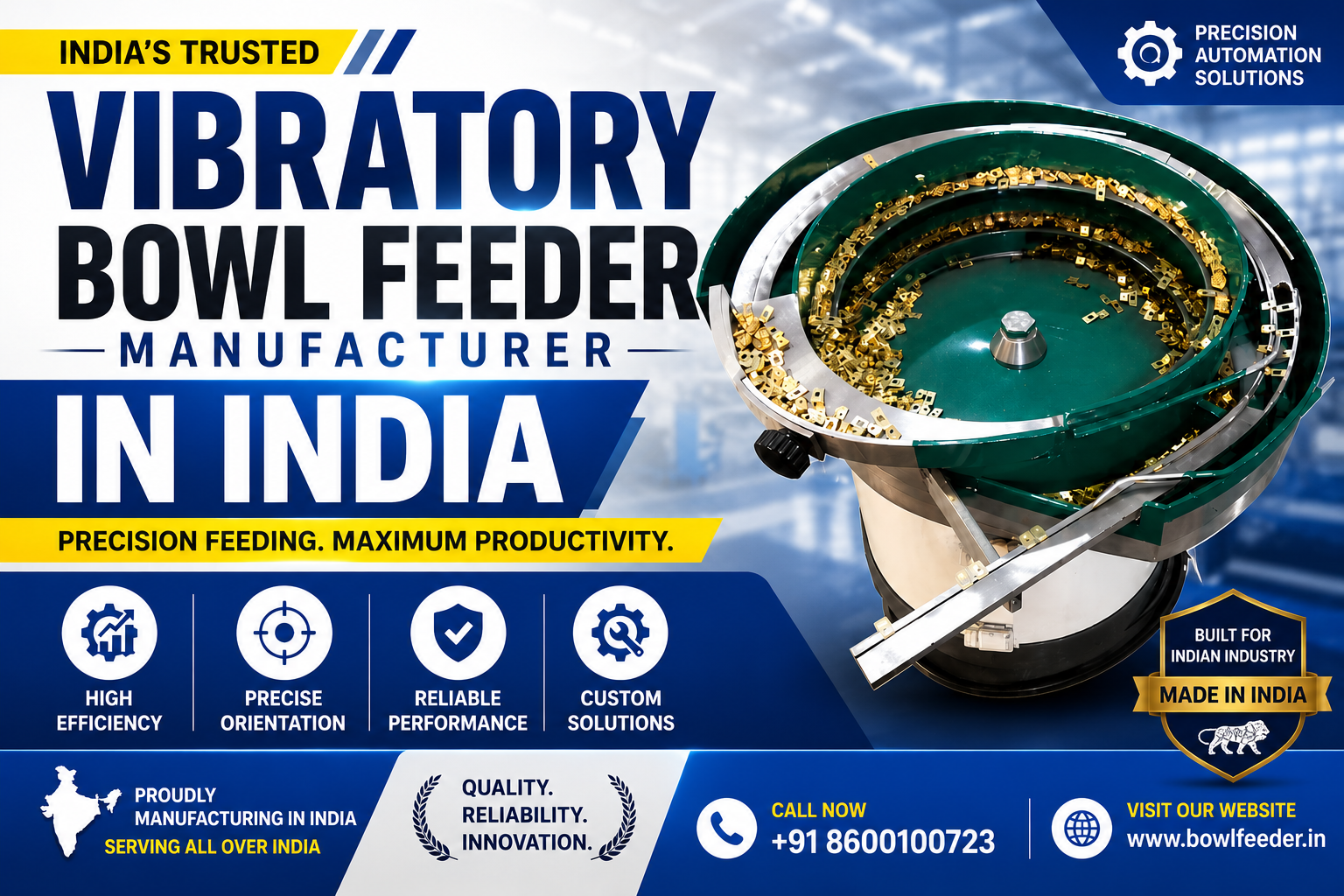
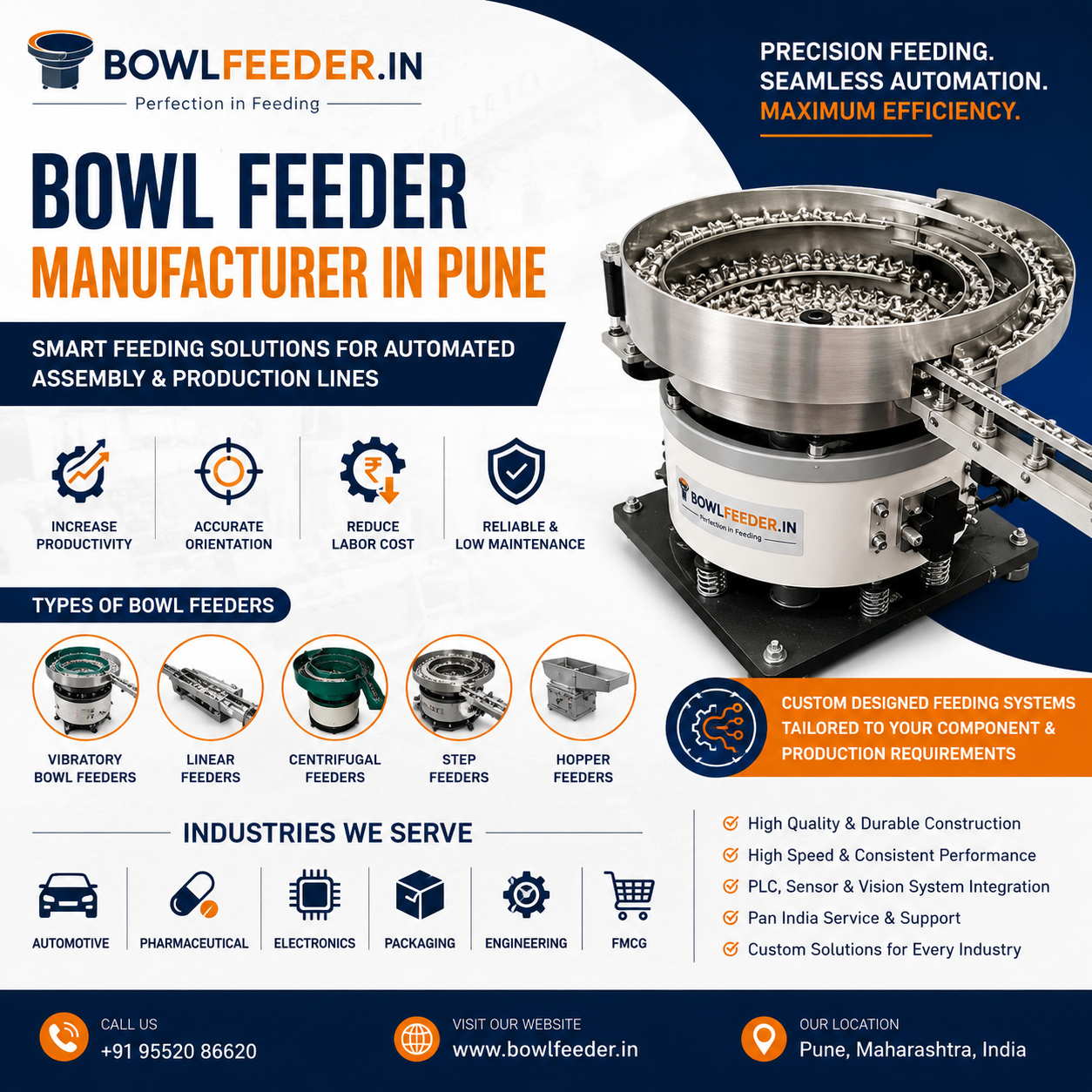
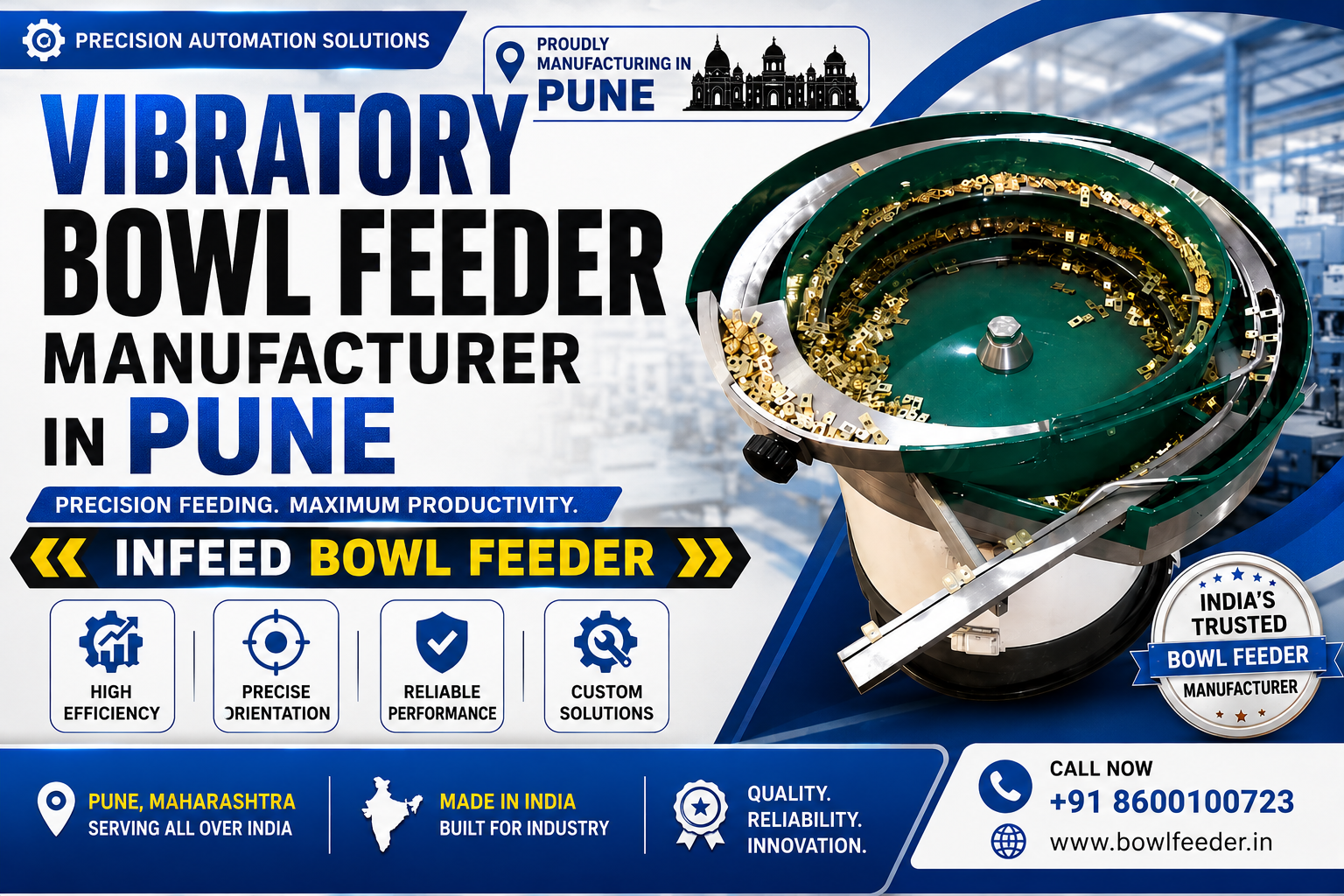
A bowl feeder, also known as a vibratory bowl feeder or parts feeder, is an automated system that sorts, orients, and dispenses small parts at high speeds. These devices use controlled vibration to move components through a circular bowl, gradually feeding them into assembly lines or packaging systems.
Bowl feeders consist of:
- The Bowl Hopper — A container where bulk parts are loaded
- Vibratory Mechanism — Electromagnets or mechanical systems that create precise vibrations
- Track/Bowl Surface — The path along which parts travel
- Orientation System — Features that ensure parts face the correct direction
- Output Chute — Where parts are dispensed to downstream equipment
How Bowl Feeders Work
The process is elegant in its simplicity:
- Operators load bulk components into the bowl
- The vibration system activates, creating controlled oscillations
- Parts gradually climb the spiral track inside the bowl
- Poorly oriented parts are automatically rejected back into the bowl
- Correctly oriented parts reach the top and are dispensed to the next production stage
This continuous cycle runs 24/7 if needed, requiring minimal operator intervention.
The Manufacturing Efficiency Challenge
Current Pain Points
Before implementing bowl feeders, manufacturers typically face several efficiency obstacles:
- Manual Part Sorting — Employees manually feeding parts onto assembly lines
- Inconsistent Feeding Rates — Production bottlenecks caused by irregular part supply
- High Labor Costs — Dedicated staff required for part handling
- Quality Variations — Human error leading to misoriented parts
- Fatigue-Related Errors — Worker exhaustion causing mistakes in repetitive tasks
- Limited Scalability — Difficulty increasing output without hiring more staff
These challenges create a productivity ceiling that traditional manufacturing methods can’t break through.
How Bowl Feeders Solve Efficiency Problems
1. Automation of Repetitive Tasks
Bowl feeders eliminate the most tedious manufacturing jobs — manual part feeding. By automating this process, manufacturers:
- Free up employees for higher-skilled tasks
- Reduce workplace monotony and associated worker fatigue
- Lower injury risks from repetitive strain
- Enable consistent, error-free part feeding 24/7
Efficiency Gain: A single operator can now oversee multiple production lines instead of managing one manually.
2. Consistent, Controlled Output
Unlike human feeders, bowl feeders deliver parts at precisely controlled rates:
- Predictable Feeding Rate — Parts dispensed at predetermined intervals
- No Downtime Variation — Consistent operation regardless of shift changes
- Synchronized Production — Parts arrive exactly when downstream equipment needs them
- Zero Waiting Time — Assembly machines never idle waiting for parts
Efficiency Gain: Manufacturers report 15-30% increases in overall production throughput.
3. Superior Part Orientation
Modern bowl feeders include sophisticated orientation mechanisms:
- Automatic Rejection System — Misaligned parts are automatically sent back for reorientation
- Zero Defect Feeding — Only correctly oriented parts proceed downstream
- Reduced Assembly Errors — Downstream equipment receives parts in optimal condition
- Lower Scrap Rates — Fewer assembly mistakes mean less wasted material
Efficiency Gain: Companies see 5-15% reductions in defect rates and rework labor.
4. Dramatically Reduced Labor Costs
The labor economics of bowl feeders are compelling:
| Aspect | Manual Feeding | Bowl Feeder |
|---|---|---|
| Operators Needed | 1 per line | 0.2-0.3 per line |
| Shift Coverage | Required | Minimal |
| Overtime Costs | Frequent | Rare |
| Training Time | Weeks | Hours |
| Consistency | Variable | Constant |
Efficiency Gain: Labor cost reduction of 60-80% for parts handling operations.
Quantifiable Efficiency Improvements
Production Speed
Bowl feeders dramatically increase production velocity:
- Feeding Rate: 30-300+ parts per minute (depending on part size)
- Uptime: 95%+ availability with modern systems
- Cycle Time Reduction: 20-40% faster assembly cycles
- Throughput Increase: Manufacturers report 50-100% production increases
Quality Metrics
Efficiency isn’t just about speed — quality matters equally:
- Defect Rate Reduction: 80-95% fewer feeding-related errors
- Assembly Success Rate: Improves from 85-90% to 99%+
- Rework Costs: Decrease by 60-75%
- Customer Returns: Reduce due to fewer defects
Operational Metrics
- Machine Utilization Rate: Increases from 60-70% to 85-95%
- Asset ROI: Typically achieved in 12-24 months
- Production Flexibility: 5-10 minute changeover times between part types
Industries That Benefit Most from Bowl Feeders
Bowl feeders excel in manufacturing sectors that handle high volumes of small parts:
Electronics Manufacturing
- Component insertion and assembly
- Circuit board preparation
- Connector feeding for automated soldering
Automotive
- Fastener and rivet feeding
- Spring and clip dispensing
- Sensor component assembly
Medical Device Manufacturing
- Sterile component feeding
- Precision screw and fastener dispensing
- Pharmaceutical tablet counting and dispensing
Consumer Products
- Battery feeding and insertion
- Plastic component assembly
- Packaging automation
Industrial Equipment
- Bearing and seal feeding
- Hydraulic component assembly
- Control system component feeding
Selecting the Right Bowl Feeder for Your Operation
Key Considerations
1. Part Characteristics
- Size and weight
- Material (plastic, metal, rubber)
- Shape complexity
- Fragility
2. Production Volume
- Required feeding rate (parts per minute)
- Daily production targets
- Peak vs. average demand
3. Orientation Requirements
- Do parts need specific orientation?
- Are there multiple acceptable positions?
- How complex is the orientation challenge?
4. Integration Needs
- Compatibility with existing equipment
- Space constraints
- Control system integration
5. Total Cost of Ownership
- Initial equipment cost
- Operating costs (electricity, maintenance)
- Labor savings
- Maintenance and support
Common Bowl Feeder Configurations
- Electromagnetic Feeders — Most common, precise control, energy efficient
- Mechanical Vibrators — Robust, high-capacity options
- Pneumatic Systems — Clean operation for food/pharmaceutical applications
- Centrifugal Feeders — High-speed applications, smaller parts
Implementation Best Practices
Phase 1: Assessment
- Analyze current bottlenecks
- Calculate labor costs
- Project efficiency gains
- Define success metrics
Phase 2: Pilot Program
- Install feeder on highest-volume line
- Train operators on new equipment
- Collect performance baseline data
- Identify optimization opportunities
Phase 3: Full Deployment
- Implement learnings across production lines
- Integrate with inventory management systems
- Establish preventive maintenance schedules
- Monitor performance metrics continuously
Phase 4: Continuous Optimization
- Track efficiency gains
- Adjust feeding rates and parameters
- Upgrade components as needed
- Plan for future capacity expansion
Overcoming Common Implementation Challenges
Challenge 1: Initial Capital Investment
Solution: The ROI is typically 1-2 years through labor savings and productivity gains. Finance through equipment leasing or production efficiency rebates.
Challenge 2: Integration with Existing Equipment
Solution: Work with equipment suppliers who have integration experience. Modern feeders are designed for compatibility with legacy systems.
Challenge 3: Learning Curve
Solution: Manufacturers report minimal training requirements. Most operators adapt within hours. Comprehensive documentation and vendor support ensure smooth transitions.
Challenge 4: Part-Specific Customization
Solution: Modern feeders offer flexible bowl designs and orientation tracks. Custom solutions handle complex part geometries.
The Future of Parts Feeding
Manufacturing is evolving rapidly, and bowl feeders are advancing alongside industry trends:
Smart Feeders with IoT Integration
- Real-time production monitoring
- Predictive maintenance alerts
- Remote diagnostics and optimization
- Integration with MES systems
AI-Powered Orientation
- Machine learning algorithms optimize feeding parameters
- Automatic adaptation to part variations
- Self-diagnosing systems that prevent downtime
Flexible Automation
- Faster changeover between part types
- Modular designs for multi-product lines
- Robotic integration for end-to-end automation
Sustainability Features
- Energy-efficient electromagnetic systems
- Noise reduction technology
- Dust collection and material recovery
Calculating Your Potential ROI
Example Calculation
Scenario: Mid-sized automotive parts manufacturer
Current State:
- 3 production lines
- 1 operator per line = 3 FTE at $45,000/year = $135,000
- Production rate: 100 units/hour per line
- Defect rate: 8%
- Rework labor: $30,000/year
With Bowl Feeders:
- 3 bowl feeders: $75,000 total ($25,000 each)
- Operators needed: 0.5 FTE = $22,500/year
- Production rate: 150 units/hour per line (+50%)
- Defect rate: 1.5% (81% improvement)
- Rework labor: $5,000/year
Year 1 Analysis:
- Labor savings: $112,500
- Rework reduction: $25,000
- Increased revenue (from 50% higher output): $150,000+
- Equipment cost: ($75,000)
- Maintenance & operating costs: ($8,000)
- Net Year 1 Benefit: $204,500+
- ROI: 273%
FAQ: Bowl Feeders and Manufacturing Efficiency
Q: How much space do bowl feeders require? A: Typically 2-3 square feet of floor space. Compact models available for space-constrained environments.
Q: Can bowl feeders handle delicate parts? A: Yes. Modern feeders offer adjustable vibration settings for fragile components, including pharmaceutical tablets and electronic components.
Q: What’s the maintenance requirement? A: Minimal. Standard maintenance includes checking bearings, cleaning debris traps, and occasional calibration. Most systems run for months without intervention.
Q: How quickly can we switch between part types? A: 5-15 minutes typically. Some modular systems achieve sub-minute changeover with pre-configured bowl setups.
Q: What’s the typical lifespan? A: 10-15 years with proper maintenance. Many systems operate successfully for 20+ years.
Q: Are bowl feeders compatible with Industry 4.0 initiatives? A: Absolutely. Modern feeders integrate with MES systems, collect performance data, and support digital transformation initiatives.
Conclusion
Bowl feeders represent one of the most impactful yet underutilized efficiency improvements available to modern manufacturers. By automating parts feeding, improving consistency, and reducing labor costs, these systems deliver extraordinary ROI while simultaneously improving product quality and worker satisfaction.
The efficiency gains aren’t marginal — manufacturers routinely report 50-100% production increases, 80-95% defect reductions, and 60-80% labor cost savings in parts handling operations. When you combine these improvements across multiple production lines, the cumulative impact transforms manufacturing operations.
Whether you’re managing a small-batch custom operation or a high-volume production facility, bowl feeders offer a proven path to higher efficiency, lower costs, and better quality. The question isn’t whether your manufacturing operation needs bowl feeders — it’s whether you can afford not to implement them.