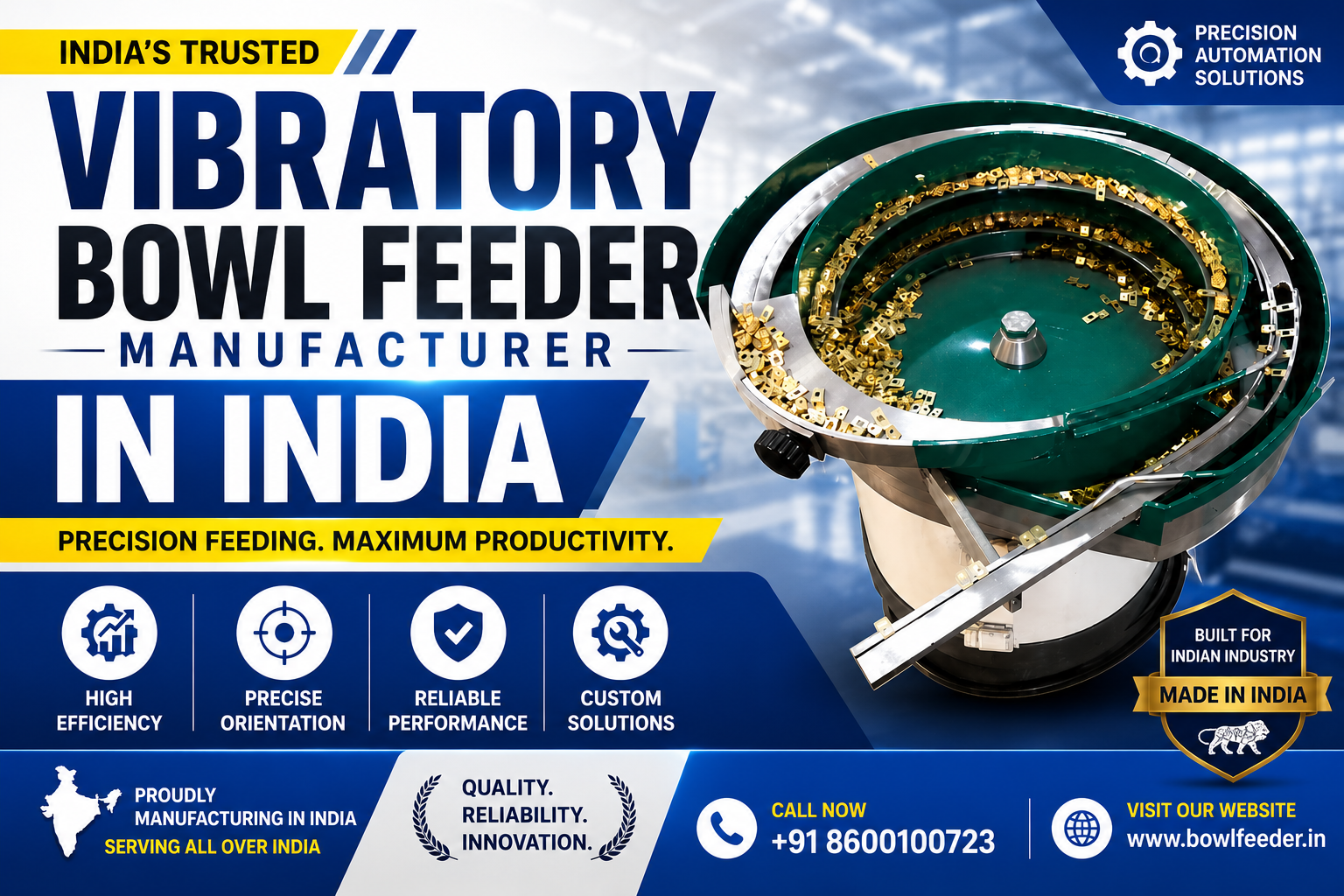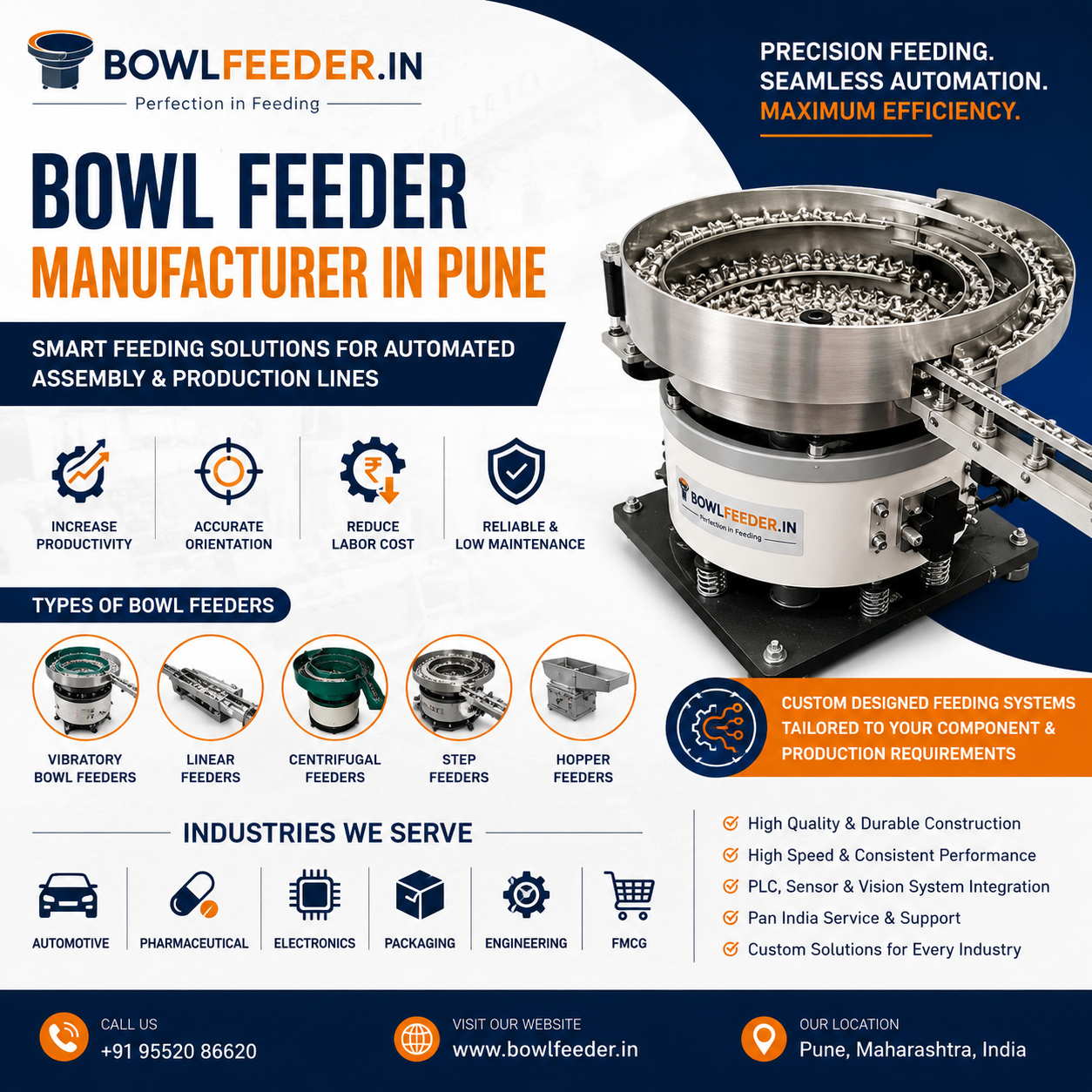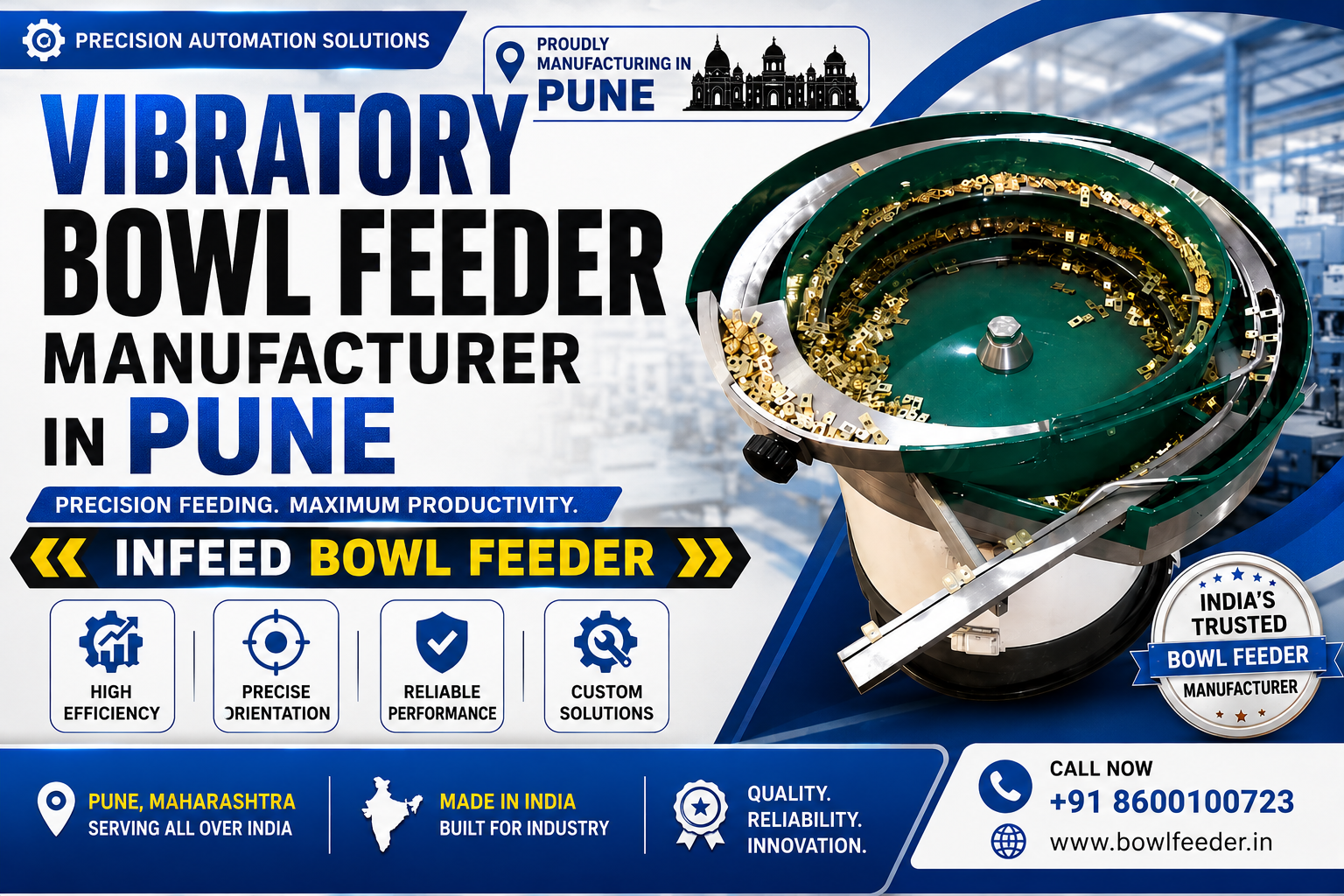
A spiral bowl feeder looks simple from the outside — a bowl, a base, a controller. But underneath that simplicity is a chain of precision decisions: material selection, tooling geometry, weld quality, vibration tuning, and orientation logic. If any link in that chain is weak, the result on the shop floor is jams, misfeeds, part damage, or a feeder that simply can’t hit its rated output.
India’s No. 1
Bowl Feeder Manufacturer
That’s why quality control (QC) in bowl feeder manufacturing isn’t a final checkbox — it’s a process built into every stage of production. This guide walks through the standards and testing methods that separate a reliable feeder from one that becomes a maintenance headache.
Why Quality Control Matters More in Bowl Feeders Than It Seems
Unlike static machine components, a bowl feeder’s entire function depends on dynamic, repeated motion — millions of vibration cycles acting on precisely engineered tooling. A tolerance error of even half a millimeter in a wiper or cutout can mean the difference between 98% correct-orientation output and a feeder that jams every few minutes.
Because tooling is custom-built around a customer’s exact part geometry, there’s no “off-the-shelf” QC checklist that fits every feeder. Instead, manufacturers need a layered quality process that catches errors at the design stage, the fabrication stage, and the final commissioning stage.
Stage 1: Incoming Material Quality Control
Before fabrication even begins, the raw materials — stainless steel or aluminum sheet for the bowl, base castings, springs, and electrical components — go through incoming inspection:
- Material certification checks to confirm the correct grade of stainless steel or aluminum
- Surface finish inspection to catch defects that could damage delicate parts or cause premature wear
- Spring and drive component testing, since the electromagnetic drive’s springs directly determine vibration consistency and feeder lifespan
- Dimensional checks on bought-out components such as controllers, sensors, and pneumatic fittings
Skipping this stage is one of the most common (and costly) shortcuts in low-cost feeder manufacturing, since a defect here surfaces only after the feeder is fully assembled.
Stage 2: Design Validation and Tooling Simulation
Before cutting metal, reputable manufacturers validate the tooling design against the actual part:
- Sample part testing – running physical prototype parts through mock-up tooling sections to confirm orientation logic works before committing to full fabrication
- CAD-based motion simulation – modeling how the part behaves as it climbs the spiral track under vibration, to predict jam points or false-pass zones
- Tolerance stack-up analysis – ensuring that cumulative tolerances across the track, tooling, and bowl don’t compound into feed inconsistency
This stage catches the majority of design flaws before they become expensive fabrication rework.
Stage 3: Fabrication and Assembly QC
During bowl fabrication and tooling installation, in-process checks typically include:
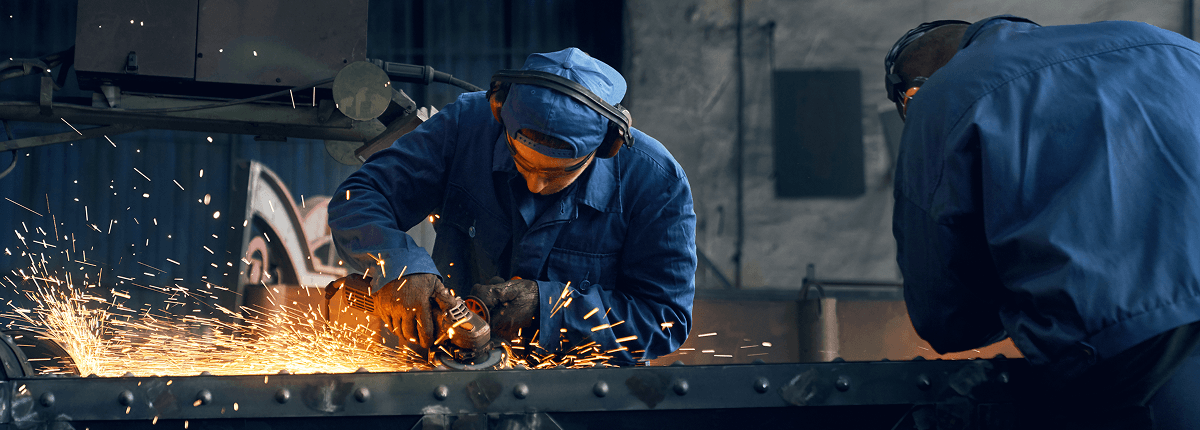
- Weld quality inspection on the bowl track and base to prevent cracking under continuous vibration loads
- Dimensional verification of tooling features (wipers, gates, rails) against CAD drawings, typically using calipers, gauges, or CMM (coordinate measuring machine) inspection for tight-tolerance applications.
- Surface polishing checks, especially for pharmaceutical or food-grade applications where surface roughness affects hygiene compliance
- Balance and alignment checks on the bowl-to-base mounting, since even slight misalignment can distort the vibration pattern
Stage 4: Vibration and Performance Testing
This is where the feeder is tested as a complete system rather than individual parts:
Frequency and Amplitude Testing
The drive unit is tested to confirm it delivers the specified vibration frequency and amplitude consistently across the operating range, since inconsistent vibration is the single biggest cause of erratic feed rates.
Feed Rate Run-Off Test
The feeder runs with actual production parts (or close equivalents) for an extended period to measure:
- Parts fed per minute
- Correct-orientation percentage (reject rate)
- Jam frequency
- Noise levels
A well-tuned industrial bowl feeder should typically sustain a 95%+ correct-orientation output rate under continuous operation, though exact benchmarks vary by part complexity and industry requirement.
Endurance / Duty Cycle Testing
For high-volume applications, feeders are run continuously over several hours (or days, for critical automotive/pharma lines) to confirm the drive unit, springs, and tooling hold up under sustained load without performance drift.
Noise and Vibration Isolation Testing
Since bowl feeders can be a significant noise source on the shop floor, decibel testing ensures the unit meets workplace noise standards, and vibration isolation mounts are checked to confirm they aren’t transmitting excess vibration to the surrounding structure.
Stage 5: Controls and Integration Testing
Modern bowl feeders are rarely standalone — they’re part of an automated line. QC at this stage covers:
- PLC and sensor calibration to confirm accurate part-present/part-absent detection
- Escapement and outlet timing tests to verify synchronized handoff to downstream robots or pick-and-place systems
- Fault and jam-detection logic testing, ensuring the controller correctly flags stoppages instead of running blind
- Electrical safety checks, including grounding, enclosure ratings, and compliance with relevant electrical standards
Stage 6: Final Inspection and Customer Sign-Off
Before dispatch, most manufacturers conduct a final witnessed run-off, often with the customer present (in person or via video), covering:
- Live demonstration with actual or sample production parts
- Confirmation of rated output speed and orientation accuracy
- Documentation handover: material certificates, tooling drawings, test reports, and operation/maintenance manuals
- Sign-off checklist covering mechanical, electrical, and performance parameters
This final stage is critical for industries like automotive and pharmaceutical manufacturing, where documented quality traceability is often a contractual or regulatory requirement.
Industry-Specific QC Considerations
Automotive: Emphasis on durability testing and consistent cycle times to match takt time requirements on high-volume lines.
Pharmaceutical and Medical Devices: Stronger focus on surface finish, material certification, and cleanroom-compatible construction, often requiring validation documentation aligned with GMP practices.
Electronics: Precision tooling tolerances to avoid damaging delicate connector pins or small components during the feeding process.
Packaging: Higher emphasis on sustained high-speed run-off testing, since packaging lines often demand the highest feed rates.
Common Quality Failures — and How Testing Prevents Them
| Failure Mode | Root Cause | QC Stage That Catches It |
|---|---|---|
| Frequent jamming | Tooling tolerance error | Design validation/fabrication QC |
| Inconsistent feed rate | Drive unit calibration drift | Vibration and performance testing |
| Part damage during feeding | Incorrect track surface finish | Fabrication QC / material inspection |
| Premature spring failure | Substandard spring material | Incoming material QC |
| Excess noise/vibration transfer | Poor base isolation mounting | Performance testing |
| Misfeeds to downstream robot | Escapement/sensor miscalibration | Controls and integration testing |
Choosing a Manufacturer With Strong QC Practices
When evaluating a bowl feeder manufacturer, ask specifically about:
- Whether they conduct sample part testing before finalizing tooling design
- What run-off duration and success-rate benchmarks they test against
- Whether material certificates and test reports are provided as standard documentation
- Their process for handling post-installation performance issues
A manufacturer that can clearly walk you through each of these stages — rather than simply promising “high accuracy” — is generally a stronger long-term partner, especially for high-volume or regulated manufacturing environments.